In the domain of industrial maintenance, construction, and facility management, executing tasks at height presents a unique set of challenges encompassing safety, precision, and operational efficiency. Aerial Work Platforms (AWPs) have emerged as the engineered solution, supplanting traditional methods like ladders and scaffolding. This definitive guide provides an engineer-level analysis of the three primary AWP categories—Boom Lifts, Scissor Lifts, and vertical mast lifts—delving into their mechanical design principles, kinematic capabilities, and application-specific suitability to empower data-driven decision-making.
1. Defining Aerial Work Platforms (AWPs): A Systems Engineering Perspective
An Aerial Work Platform (AWP) is a mobile, mechanically or hydraulically actuated system designed to position personnel, tools, and materials at a designated working height with a stable, enclosed platform. From a systems engineering standpoint, an AWP integrates structural, mechanical, hydraulic, electrical, and control subsystems to achieve safe vertical and/or horizontal displacement. Regulatory compliance is not an adjunct but a foundational design constraint. Globally, standards such as ANSI/SAIA A92 (North America) and the Machinery Directive 2006/42/EC (Europe, requiring CE marking) govern design, manufacturing, testing, and use. These standards mandate rigorous risk assessment, structural calculations, stability tests, and the incorporation of safety devices (e.g., load sensing, tilt sensors, emergency descent), establishing a formalized safety integrity level for operations.
2. Technical Deep Dive: Primary AWP Classifications
2.1 Boom Lifts: Articulated and Telescopic Kinematics
Boom lifts are characterized by an articulated or telescopic arm (boom) providing extended horizontal reach and obstacle-overcoming capability. Their kinematics define their application envelope.
- Articulating (Knuckle) Booms: Feature multiple hinge points (knuckles), enabling complex, non-linear path planning. The kinematic chain allows the platform to "fold" and maneuver over/under obstructions. Key engineering parameters include the number of axes of articulation, maximum stowed height, and the continuous slewing capability of the turntable.
- Telescopic (Straight) Booms: Utilize a single, linearly extending arm via nested hydraulic cylinders or a chain-and-sprocket mechanism. This design prioritizes maximum horizontal outreach from the chassis. Critical analysis focuses on the moment load diagram, which defines the safe working envelope as a function of boom angle and extension.
- Propelled/Crawler Booms: Integrate the boom superstructure onto a tracked undercarriage. The crawler system offers a low ground pressure (measured in psi or kPa) and enhanced traction on unimproved, uneven, or soft terrain. Engineering considerations include the gradeability (often exceeding 45%), ground clearance, and the independent control of each track for precise spotting.
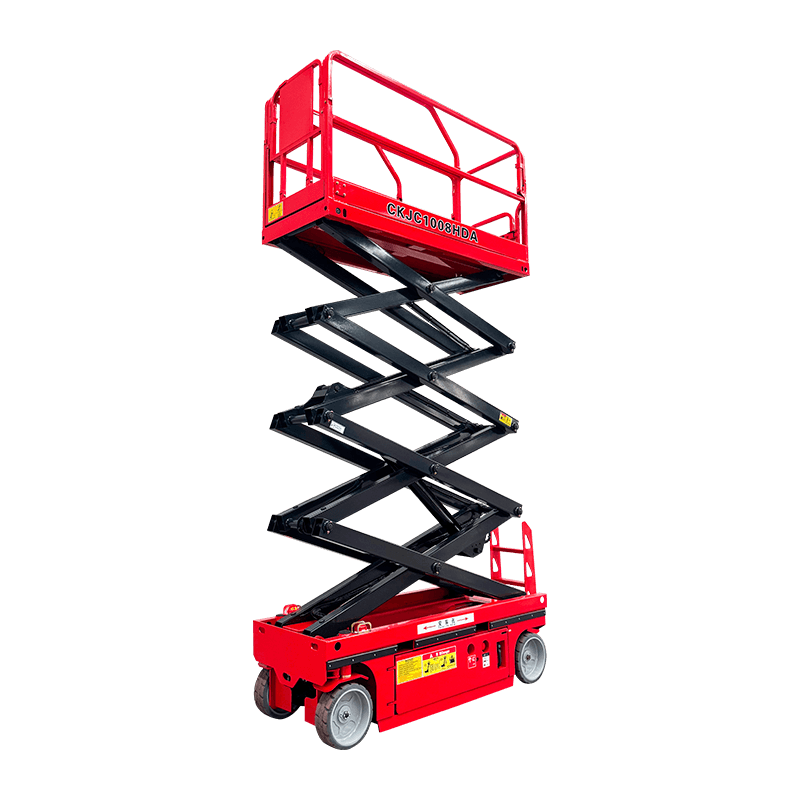
2.2 Scissor Lifts: Vertical Translation via Pantographic Mechanisms
Scissor lifts employ a linked, folding pantographic (scissor) mechanism to achieve strictly vertical platform translation. The system's mechanics are governed by the principles of a collapsing "N" pattern, where hydraulic cylinder force is multiplied into vertical lift. The primary engineering advantages are:
- High Structural Rigidity and Load Capacity: The triangulated scissor arms provide excellent resistance to bending moments, supporting large deck areas (often 20+ sq ft) and significant distributed loads (e.g., 1000+ lbs).
- Stability: The wide base-to-height ratio and low center of gravity during travel enhance stability, though outriggers are critical for extended height applications per ANSI A92.20 stability tests.
Applications are typically large-area, vertical-access tasks in industrial plants, warehouses, and assembly facilities where a stable, spacious work surface is paramount.
2.3 Vertical mast lifts: Precision Engineering for Confined Spaces
Vertical mast lifts, also termed personnel lifts or push-around lifts, represent a specialized solution engineered for maximum spatial efficiency. The core design principle is vertical translation via one or more interlocking mast sections, guided by precision rollers or bearings within a chassis of minimal footprint.
2.3.1 Critical Design and Selection Parameters
Selecting a vertical mast lift requires a rigorous analysis of specifications against operational constraints.
- Working Height vs. Platform Height: A fundamental specification confusion arises from the question: What is the maximum working height of a vertical mast lift? Engineers must distinguish between *Platform Height* (the height of the guardrail) and *Working Height* (the maximum reachable height for a worker, typically Platform Height + ~2m). The design load moment and structural safety factor are calculated based on the fully extended mast configuration.
- Powerplant Analysis: Evaluating an Electric vertical mast lift price and specifications involves a total cost of ownership (TCO) model. Electric drives (24V or 48V DC) offer zero local emissions, low noise (<70 dBA), and reduced maintenance (no hydraulics in some models), making them ideal for sensitive indoor environments. Technical specs must include battery amp-hour (Ah) rating, charger type, and duty cycle.
- Mast Configuration and Stability: Masts can be single, dual, or triple stage. A wider mast profile (often dual) increases side-to-side stability and resistance to deflection under load. The Small vertical mast lift for narrow aisle applications often uses a single, centrally-located mast to achieve widths under 32 inches (810mm), but may have a reduced platform capacity or different deflection characteristics.
2.3.2 Operational Advantages and Rationale
The decision to deploy a mast lift is driven by quantified benefits. An engineering assessment of the Benefits of using vertical mast lifts in warehouse maintenance reveals:
- Spatial Optimization: Minimal envelope intrusion preserves aisle width and storage density. The footprint is often less than 25% of a comparable-capacity scissor lift.
- Ergonomic and Productivity Gains: Eliminates the fatigue and hazard of ladder use. The platform provides a stable base for tools, allowing for longer, more productive work cycles with two-handed operation.
This directly addresses the fundamental query: Why choose a vertical mast lift over a ladder? The answer is a quantifiable reduction in fall risk (a leading cause of workplace injury) and a measurable increase in task efficiency and quality.
2.3.3 Safety and Maintenance Protocols
Safety is an engineered outcome, not an assumption. The procedure for How to operate a vertical mast lift safely is codified in standards and must include:
- Pre-Operational Inspection: Check structural integrity, guardrails, gate interlocks, wheel and castor condition, and control functionality.
- Site Hazard Assessment: Verify floor loading capacity, identify overhead obstacles, and ensure the area is cordoned off.
- Stability Management: Never move the unit while elevated. Use outriggers if provided and specified in the manual.
Reliability is ensured through a preventive maintenance schedule. The protocol for How to maintain and service a vertical mast lift involves scheduled tasks: lubricating mast rollers/chains, checking and torquing fasteners, inspecting wire ropes or hydraulic cylinders for wear, load testing safety devices, and verifying electrical system integrity.
3. Advanced Selection Methodology: A Comparative Engineering Analysis
3.1 Decision Matrix Based on Operational Parameters
Selection is a multi-variable optimization problem. Key independent variables include: Required Working Height (H), Horizontal Reach (R), Aisle Width Constraint (Wa), Ground Conditions (G), and Duty Cycle (C).
3.2 Head-to-Head System Comparison
A frequent engineering trade-off in confined interiors is captured by the question: Vertical mast lift vs scissor lift: which is better for indoor use? The following table provides a systems-level comparison.
| Engineering Parameter |
Vertical Mast Lift |
Scissor Lift |
| Kinematic Function |
Pure vertical translation (Z-axis). |
Pure vertical translation (Z-axis) with larger base. |
| Spatial Footprint & Mobility |
Minimal footprint (W < 36"). Can navigate standard pallet rack aisles. Manually propelled or low-speed drive. |
Large footprint. Requires wide aisles for maneuvering. Typically self-propelled with higher travel speed. |
| Structural Load Capacity |
Moderate (e.g., 300-500 lbs). Concentrated load on mast(s). |
High (e.g., 1000-1500 lbs). Distributed load across scissor structure. |
| Primary Indoor Use Case |
Vertical mast lift for ceiling installation work, HVAC service, high-density storage rack maintenance, and lighting retrofit in constrained spaces. |
Large-area wall finishing, mechanical installation requiring extensive tooling, long-duration assembly tasks in open-plan facilities. |
3.3 Sourcing and Lifecycle Considerations
The final step involves procurement strategy. For short-term or project-specific needs, the query Where to rent a vertical mast lift near me leads to a technical rental evaluation: inspecting the unit's inspection and maintenance log (per ANSI A92.22), verifying current load plate and manual, and confirming the functionality of all safety devices. For long-term, high-utilization scenarios, purchasing involves a detailed lifecycle cost analysis weighing initial capital expenditure against expected maintenance, energy consumption, and residual value.
4. Conclusion: A Systems-Based Selection Philosophy
Selecting the optimal AWP is an exercise in applied systems engineering. It requires mapping the technical specifications and kinematic capabilities of Boom Lifts (for reach), Scissor Lifts (for stability and load), and vertical mast lifts (for spatial constraint resolution) onto a well-defined set of task requirements and environmental constraints. The highest weight must always be assigned to safety parameters and regulatory compliance. By adopting this analytical approach, facility managers, project engineers, and safety officers can specify equipment that not only gets the job done but does so with maximized efficiency, minimized risk, and engineered reliability.
5. Frequently Asked Questions (FAQ)
Q1: Our facility has aisles under 40" wide. What AWP options exist for servicing lights at 25 ft?
A: This is the definitive application for a Small vertical mast lift for narrow aisle applications. You must select a model with a chassis width less than your clear aisle width (typically <36") and a platform height exceeding your required working height (25ft working height ≈ 23ft platform height). Ensure the unit's turning radius is compatible with your aisle intersections.
Q2: For indoor factory lighting maintenance, how do I technically decide between a mast lift and a scissor lift?
A: The core technical decision hinges on spatial constraints versus task requirements, as outlined in the Vertical mast lift vs scissor lift: which is better for indoor use? comparison. Perform a measurement survey: if aisles are wide (>6ft) and tasks involve multiple fixtures requiring significant tools/materials, a scissor lift may be more efficient. If aisles are narrow (<4ft) and tasks are sequential, single-point repairs, a mast lift's accessibility will result in greater overall productivity despite a potentially slower cycle time per fixture.
Q3: From a safety engineering standpoint, what is the primary advantage of a mast lift over a ladder?
A: Why choose a vertical mast lift over a ladder? The principal advantage is the provision of a collective fall protection system. A ladder relies on user balance and training (a personal protective measure). A mast lift provides an engineered guardrail system (toeboards, midrails, gate) that acts as a passive fall prevention system, effectively eliminating the fall hazard for all users, which is a higher-order control in the hierarchy of risk controls.
Q4: When reviewing specifications, what is the precise engineering definition of "maximum working height"?
A: When asking What is the maximum working height of a vertical mast lift?, you must request the defined test methodology. Per ANSI/SAIA A92 standards, it should be the vertical distance from the floor to the top of the guardrail (platform height) OR the maximum attainable reach height for a 6-foot tall person. Reputable manufacturers provide both figures. The structural design and stability calculations are based on the platform height with maximum rated load.
Q5: We are evaluating electric mast lifts for a clean-room environment. What technical specs beyond price are critical?
A: When analyzing Electric vertical mast lift price and specifications for a controlled environment, your technical checklist must include: 1) Material and Finish: Electrophoretic or powder-coated paint to resist corrosion and prevent particle shedding. 2) Contamination Control: Sealed bearings, non-marking castors, and optionally, a regenerative drive system to minimize brake dust. 3) Battery Chemistry: Sealed lead-acid (SLA) or Lithium-ion (Li-ion). Li-ion offers longer life, faster charge, and no off-gassing but at a higher CAPEX. 4) EMI/RFI Emissions: Ensure the motor controller complies with facility electromagnetic interference requirements.
6. References & Industry Standards
- ANSI/SAIA A92.20 - 2021: "Design, Calculations, Safety Requirements and Test Methods for Mobile Elevated Work Platforms (MEWPs)"
- ANSI/SAIA A92.22 - 2021: "Safe Use of Mobile Elevated Work Platforms (MEWPs)"
- ISO 16368:2020 "Mobile elevating work platforms — Design calculations, safety requirements and test methods"
- OSHA 29 CFR 1926.453 - "Aerial Lifts" (U.S. Occupational Safety and Health Administration)
- The Machinery Directive 2006/42/EC (European Union)
- Proctor, S.P., & Mitera, J. (2018). Fall Protection and Aerial Work Platform Safety: An Engineering Guide. American Society of Safety Professionals.

 English
 Español
 عربى
عربى