
 English
 Español
 عربى
عربى

0-100000kg Professional Custom Lifting Platform
We have a professional team with decades of industry experience. Relying on the continuous in-depth development of the s...

Content
The modern job site is defined by complexity—tight deadlines, congested layouts, and increasingly ambitious architectural designs that demand precision work at significant heights. In this environment, selecting the optimal piece of access equipment is not merely a logistical task; it is a critical strategic decision that directly impacts project safety, productivity, and cost-efficiency. The choice between the primary categories of Boom lifts (articulated, propelled/crawler) requires a nuanced understanding that goes beyond just maximum working height. It involves a detailed analysis of the machine's kinematic envelope, its interaction with challenging terrain, its duty cycle capacity, and its total cost of ownership. This guide serves as an essential technical and operational resource for project managers, equipment fleet supervisors, and procurement specialists. We will dissect the key specifications, conduct a thorough financial analysis of rental versus purchase, underscore the non-negotiable elements of safety, and explore the industry-defining trends of electrification and smart technology that are reshaping equipment expectations globally. The modern manufacturer's role, exemplified by forward-thinking companies with integrated R&D and robotic production lines dedicated to Aerial Work Platforms (AWP), is to translate these complex requirements into durable, intelligent, and high-performance machines that operators can trust on demanding sites from construction to industrial logistics.
Before any financial or operational planning, a foundational grasp of technical specifications is paramount. A machine's datasheet tells the story of its capabilities and limitations. For a propelled crawler boom lift specifications list, key metrics extend far beyond the headline "working height." The horizontal reach, or the maximum distance the platform can extend from the machine's center, is often more critical for navigating over obstacles. Platform capacity must account for the combined weight of workers, tools, and materials. Perhaps most defining for a crawler model is its ground pressure, measured in pounds per square inch (psi), which determines its ability to operate on sensitive surfaces like finished floors or landscaped areas without causing damage. The traction system's gradeability, typically expressed as a percentage, indicates the slope it can safely ascend and descend under load. Simultaneously, for large-scale construction projects, the need for a heavy duty articulated boom lift for construction is defined by more than just lift capacity. It encompasses the structural design philosophy, using high-strength steel and robust welding techniques to handle the dynamic stresses of lifting heavy materials like steel beams or precast concrete panels. The duty cycle—the machine's ability to perform sustained, intensive work without overheating or requiring maintenance—becomes a defining factor in keeping a project on schedule.

| Specification | Articulated Boom Lift (Typical 40-80 ft) | Propelled Crawler Boom Lift (Typical 40-100 ft) |
| Primary Terrain | Firm, stable surfaces; paved or compacted ground. | Soft, uneven, or sensitive terrain; finished floors; landscaped areas. |
| Maneuverability | Excellent in open spaces; requires a wider path for turning. | Superior with zero-turn capability and independent track control for precise spotting in tight spaces. |
| Setup/Stabilization | Requires outrigger deployment on most models, needing a larger footprint. | Often has outriggers but can frequently operate from the crawler base alone, enabling faster setup and work in confined areas. |
| Ideal Use Case | Exterior building maintenance, electrical work on open sites, long-reach tasks over obstacles. | Indoor construction, steel erection on unfinished floors, work around delicate landscaping, sites with mud or gravel. |
The decision to rent or purchase is a fundamental financial strategy that hinges on usage patterns, cash flow, and long-term business goals. Analyzing an articulating boom lift rental daily rate requires looking beneath the advertised price. This rate is influenced by the machine's reach and capacity, the rental duration (with weekly and monthly rates offering significant discounts), geographic market competition, and crucially, what is included. Does the rate encompass insurance (liability and physical damage), delivery and pick-up, and a maintenance service agreement? For a company with sporadic need or a single short-term project, rental offers flexibility and transfers the risks of depreciation and major repairs to the rental house. However, for frequent users, a purchase analysis for an electric articulated boom lift for sale becomes compelling. This involves calculating the Total Cost of Ownership (TCO): the upfront purchase price, plus financing costs, estimated annual maintenance, energy consumption (significantly lower for electric models), insurance, and estimated residual value at the end of a 5-7 year ownership period. The growing regulatory push for low-emission zones in cities and corporate ESG (Environmental, Social, and Governance) mandates are making electric models not just an operational choice but a strategic one, often with a stronger residual value. Sourcing from a manufacturer with vertical integration—controlling design, advanced laser cutting, robotic welding, and electrophoretic painting—ensures build quality that translates directly into higher uptime and lower lifetime maintenance costs, fundamentally improving the TCO equation.
No discussion of equipment selection is complete without placing safety at its core. The machine itself is only one component of a safe system; the most critical element is a thoroughly trained operator. An accredited Aerial Work Platforms (AWP) safety training course is not a suggestion—it is a legal and moral imperative in most jurisdictions. Effective training goes beyond basic controls, covering pre-operation inspection procedures, recognition of site-specific hazards (overhead power lines, unstable surfaces, wind conditions), and understanding the machine's stability envelope and load dynamics. A rigorous pre-use inspection must become a non-negotiable ritual, involving a walk-around check of tires/tracks, structural components for damage, fluid levels, functionality of all controls and emergency descent systems, and verification of safety devices like tilt sensors and alarms. For a propelled crawler boom lift operating indoors, a key part of the site assessment is verifying floor load capacity to prevent catastrophic collapse. Safety is a culture, championed from management down, and investing in comprehensive training and strict protocols is the most effective risk mitigation strategy a company can employ.
| Hazard Category | Potential Risk | Preventive Control Measure |
| Electrical Contact | Electrocution from touching or approaching energized power lines. | Maintain a minimum safe distance (e.g., 10 feet for lines up to 50kV); use a dedicated spotter; assume all lines are live. |
| Tip-Over / Instability | Machine overturning due to operating on slope, over side-reach limit, or hitting an obstruction. | Always operate on firm, level ground within manufacturer-rated slope limits; use outriggers as required; utilize machine-mounted level and reach indicators. |
| Fall from Platform | Worker falling due to improper use, lack of harness, or being ejected by machine movement. | Mandate use of a full-body harness with lanyard attached to designated anchor points; maintain firm footing on platform floor; move smoothly with controls. |
| Entanglement / Crush | Injury from being caught between the boom and a structure, or during machine articulation. | Maintain constant awareness of the machine's moving parts and the surrounding structure; use spotters in congested areas. |
The aerial work platform industry is undergoing a profound transformation, driven by environmental regulations and digital technology. The shift towards electrification is no longer a niche trend but a central design principle for new equipment. This is driven by stringent emissions standards in urban centers, indoor air quality requirements, and the corporate world's demand for sustainable, green equipment solutions. An electric articulated boom lift for sale today is a sophisticated piece of machinery, powered by high-capacity lithium-ion battery packs that can deliver a full shift of intensive work, with fast charging options available. Beyond power, intelligence is being embedded into the machine's core. Modern platforms feature advanced telematics systems that provide real-time data on location, usage hours, battery status, and fault codes, enabling predictive maintenance and reducing unplanned downtime. Load sensing systems prevent overloading, and some models incorporate anti-collision and zone-restriction technologies that use sensors to automatically slow or stop the machine to prevent contact with obstacles or entry into predefined hazardous areas. For global manufacturers, the challenge and opportunity lie in designing versatile platforms that meet diverse international safety standards (like ANSI, CE, GB) and can withstand varied climatic conditions, from desert heat to freezing temperatures, all while integrating these smart, sustainable technologies.
The primary advantages are superior traction, lower ground pressure, and enhanced maneuverability in confined spaces. The tracked undercarriage distributes the machine's weight over a larger area, resulting in a ground pressure often below 5 psi, allowing it to operate on finished floors, turf, or soft terrain without causing damage. The independent track control provides true zero-radius turning, enabling the operator to spin on the spot and position the platform with pinpoint accuracy in congested indoor sites or around obstacles, a feature wheeled models with a fixed axle cannot match.
Weekly rental rates for a standard 40-foot articulating boom lift rental daily rate can vary significantly by region, season, and equipment availability, but a general range in North America is between $1,200 to $2,000 per week. This base rate often excludes additional costs like transportation (which can add several hundred dollars), insurance (damage waiver), fuel, and taxes. It is crucial to get a detailed "all-in" quote from the rental provider that includes these ancillary fees to accurately budget for the project. Rates for an equivalent electric model may be slightly higher due to newer technology and lower maintenance demands for the rental company.
Yes, modern electric boom lifts are engineered for full-shift, demanding construction work. Advancements in lithium-ion battery technology provide high energy density and consistent power delivery. Many models are now equipped with onboard opportunity chargers that can replenish the battery during operator breaks or lunch, and some systems support fast-charging during longer downtimes. When evaluating an electric articulated boom lift for sale, review the manufacturer's data on battery ampere-hour (Ah) rating and typical duty cycle to ensure it matches your expected work intensity. For most single-shift applications, a properly specified electric lift is more than capable.
A comprehensive Aerial Work Platforms (AWP) safety training course must include, at a minimum: 1) Hazard Recognition: Identifying fall, tip-over, electrical, and crush hazards. 2) Machine-Specific Operation: Detailed review of the operator's manual, controls, safety devices, and load charts. 3) Pre-Operation Inspection & Function Tests: Hands-on practice of a systematic inspection routine. 4) Workplace Inspection: How to assess the job site for hazards like slopes, holes, debris, and overhead obstructions. 5) Emergency Procedures: Training on how to use manual descent systems and report incidents. The course should conclude with a written evaluation and a practical skills assessment, resulting in a formal operator authorization card or certificate as per OSHA 1926.454 or local equivalent standards.
For steel erection, prioritize a heavy duty articulated boom lift for construction with these key specs: 1) High Platform Capacity: Look for models with a 1,000 lb (454 kg) or higher capacity to safely accommodate two workers with heavy tools (torque guns, welding leads) and connection materials. 2) Robust Structural Design: Inquire about the steel grade used in the booms, the welding procedures (automated robotic welding ensures consistency), and the machine's overall duty cycle rating. 3) Reach and Up-and-Over Clearance: Ensure the machine's horizontal reach and ability to articulate "up and over" obstacles can access all connection points on the steel framework. 4) Durable Undercarriage: A rugged drive system with high-gradeability is essential for navigating the uneven, often muddy terrain of a steel erection site.
We have a professional team with decades of industry experience. Relying on the continuous in-depth development of the s...
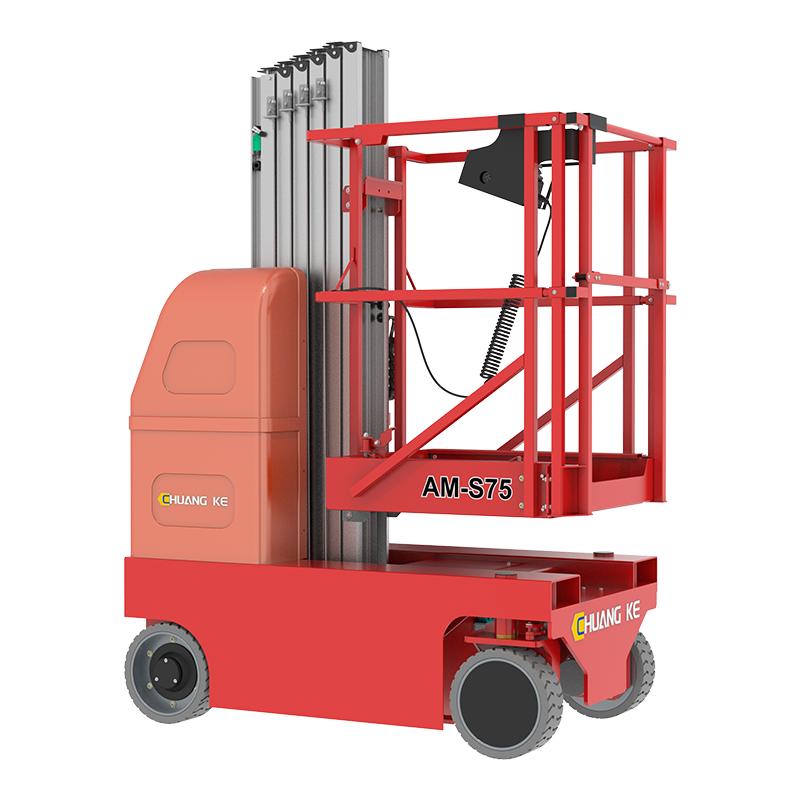
This self-propelled single mast aluminum alloy lift platform is built with high-strength aluminum alloy, offering a ligh...
The hydraulic self-propelled scissor lift aerial work platform can be easily driven and moved on flat and solid ground a...
Semi-electric scissor lifts platform are lighter and smaller in size, making it easier for workers to lift or lower the ...

