
 English
 Español
 عربى
عربى

0-100000kg Professional Custom Lifting Platform
We have a professional team with decades of industry experience. Relying on the continuous in-depth development of the s...

Content
In the landscape of modern material handling, the order picker forklift has emerged as a specialized asset for high-density storage environments. As warehouses move toward vertical expansion to optimize footprint, the engineering integrity of the mast structure becomes the primary determinant of operational throughput. At heights exceeding 9 meters, even a fractional degree of mast deflection can lead to significant tip-sway, directly impacting the operator's ability to pick items accurately and safely. Backed by over two decades of industrial manufacturing excellence, our approach prioritizes structural rigidity and vibration dampening to ensure that maximum lift heights do not compromise picking precision.
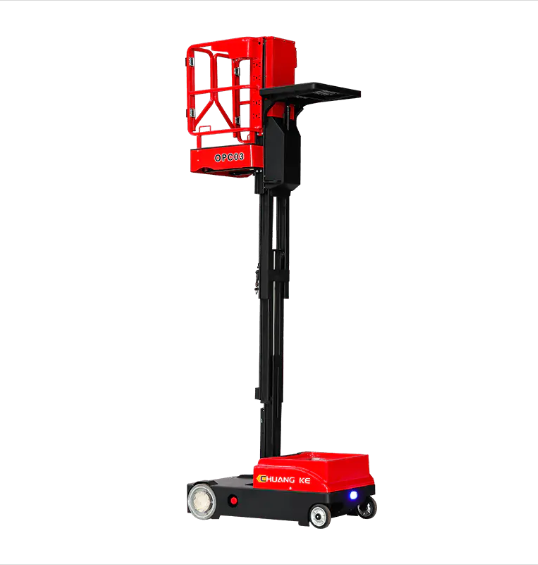
The physics of high-level picking dictates that mast sway increases exponentially with lift height. For an operator using a high-level order picker forklift for very narrow aisle (VNA) warehousing, the structural damping of the mast is essential. While a standard mast might experience prolonged oscillations after a sudden stop, a precision-engineered reinforced mast utilizes high-tensile steel and nested channel designs to dissipate kinetic energy rapidly. This reduction in sway directly translates to shorter wait times for the operator to align with the pallet, thereby increasing the "lines per hour" metric in tight VNA configurations.
| Mast Engineering Feature | Standard Industry Mast | Reinforced VNA Precision Mast |
| Mast Oscillation Recovery | 3.5 - 5.0 seconds | 1.2 - 2.0 seconds |
| Lateral Deflection at 10m | Significant (>150mm) | Minimal (<60mm) |
| Picking Accuracy Impact | High Risk of Misalignment | High Precision Alignment |
The surge in e-commerce has necessitated a shift toward high-frequency picking cycles. Integrating advanced order picker forklift safety systems for high-frequency e-commerce fulfillment allows for automated speed reduction based on lift height and steering angle. According to the latest 2024-2025 technical report by the Industrial Truck Association (ITA), the implementation of electronic stability control and active mast damping has been shown to reduce warehouse rack-collision incidents by up to 28% in high-velocity distribution centers. These systems work by monitoring the center of gravity in real-time, ensuring that the mast remains vertical even during rapid acceleration or braking.
Source: Industrial Truck Association - Forklift Safety and Engineering Statistics
Operational efficiency is also a product of human performance. By incorporating ergonomic order picker forklift features to reduce operator fatigue, such as anti-vibration floor mats and clear-view mast visibility, operators maintain higher focus levels during 8-hour shifts. A stable platform reduces the physical compensatory movements an operator must make to counter-balance mast sway, leading to a more sustainable picking pace.
The transition to electrification in logistics is no longer just about emissions, but about consistent power delivery. An electric order picker forklift with lithium-ion battery for 24/7 operations provides a constant voltage discharge curve. Unlike lead-acid batteries that suffer from voltage drops as they discharge, lithium-ion systems ensure that the hydraulic pumps receive full power even at 20% state-of-charge, maintaining consistent mast lift speeds and stability throughout the shift.
Furthermore, specialized inventory requires adapted hardware. A heavy-duty order picker forklift with customized platform for bulky goods utilizes a wider chassis and reinforced outriggers to manage the moment of force generated by oversized items. While a standard platform is optimized for small parcel picking, the customized heavy-duty variant ensures that the center of gravity remains within the stability triangle, even when handling non-uniform loads at height.
| Operational Requirement | Lead-Acid Battery System | Lithium-Ion Battery System |
| Power Consistency | Voltage drops under load | Constant voltage output |
| Charging Strategy | 8h Charge + 8h Cool-down | Opportunity charging (Fast) |
| Productivity Level | Declines mid-shift | 100% Efficiency 24/7 |
Investing in a high-stability order picker forklift is a strategic decision that impacts the entire supply chain's reliability. By reducing mast sway and integrating smart safety systems, facilities can achieve higher picking accuracy and lower maintenance costs due to reduced mechanical stress. As an industry leader with a deep commitment to quality and innovation, we continue to engineer solutions that transform mast stability into a measurable return on investment for global B2B partners.
We have a professional team with decades of industry experience. Relying on the continuous in-depth development of the s...
This self-propelled single mast aluminum alloy lift platform is built with high-strength aluminum alloy, offering a ligh...
The 3-meter self-propelled order picker is equipped with a planetary gear transmission motor. Through a high-efficiency,...
The mini electric mobile scissor lift with universal wheel integrates lifting, walking and operation functions. It adopt...

