
 English
 Español
 عربى
عربى

CKJC0705EH CKJC0604EH CKJC0503EH Mini Electric Hydraulic steering Mobile Scissor Lift
The CKJC0705EH CKJC0604EH CKJC0503EH mini electric hydraulic steering mobile scissor lift is designed for efficient oper...

Content
A maintenance crew walks into a 40,000-square-meter distribution center with a work order covering 30 light fixtures, 14 mezzanine guardrail repairs, and several overhead conveyor inspections. The ladder is too short, and the forklift cage is too slow to reposition between aisles. The job needs a machine that lifts two workers to a working height around 8 meters and travels quickly across a wide floor. That machine is a mobile hydraulic lift platform.
Choosing one is not about picking the tallest model within budget. Working height, platform capacity, power type, aisle width, floor conditions, and repositioning frequency separate the right fit from an expensive mistake. This guide covers what these machines are, how the main variants compare, what to check before purchase, and how to evaluate a manufacturer.
A mobile hydraulic lift platform is a powered elevating work platform mounted on wheels or casters and moved between working positions on a job site. Hydraulic cylinders extend a scissor linkage, a vertical mast, or another lifting structure, providing smooth travel, creep-free position holding, and predictable behavior under load. Some units are semi-electric, with an electric pump raising the platform while the operator pushes the machine. Others are fully self-propelled with electric traction and, on compact models, hydraulic steering. Warehouse variants, such as stock pickers and high-altitude reclaimers, add narrow chassis and small platforms for shelf access. The common thread is that a battery or electric motor drives a hydraulic pump, which supplies pressure to the lift cylinders.
The scissor lift is the most widely used mobile hydraulic lift platform in general industry. A crisscrossing linkage extends vertically when hydraulic cylinders push the pivot points apart, raising a rectangular platform with enough room for two operators plus tools. For maintenance, installation, and inspection work, that large platform area is often the decisive advantage over narrower lift types.
Where the machine will be moved relatively short distances, a semi-electric design is a practical and cost-effective choice. Wizplus's semi-electric scissor lift series covers working heights from 5 to 16 meters, with hydraulic lifting powered by a battery and electric motor while the operator handles travel manually.
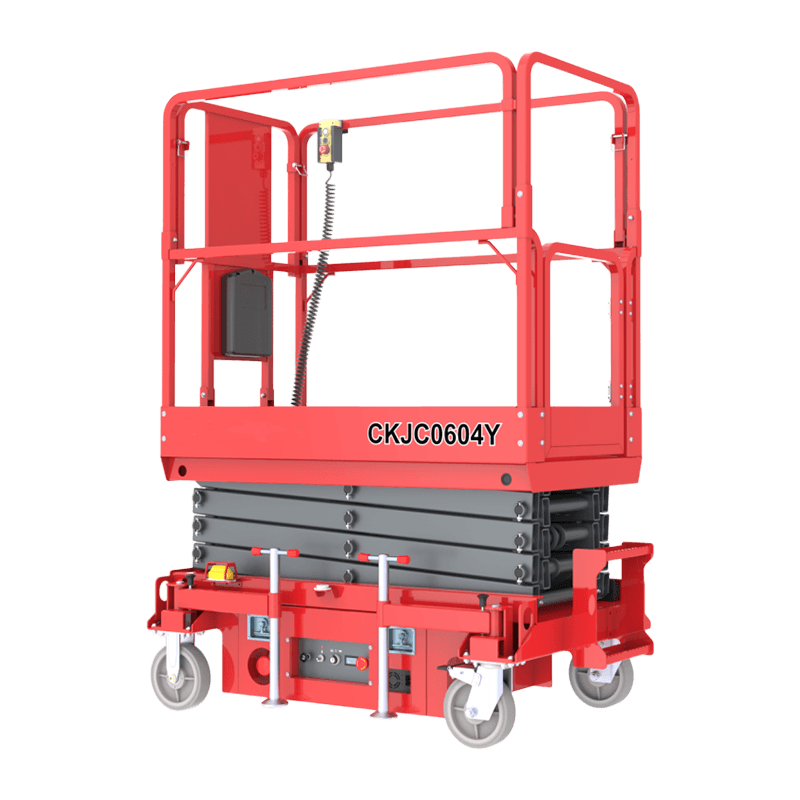 Wholesale CKJC0503Y CKJC0604Y CKJC0705Y CKJC0806Y CKJC1008Y CKJC1210Y CKJC1412Y Zhejiang Wizplus Smart Equipment Ltd is top China wholesale CKJC0503Y CKJC0604Y CKJC0705Y CKJC0806Y CKJC1008Y CKJC1210Y CKJC1412Y CKJC161...View Product →
When aisle width is the constraint, full-size scissor lifts do not fit. Mini scissor lifts with hydraulic steering are designed for warehouse aisles, crowded production floors, and doorways that a standard machine cannot pass through. The compact footprint reduces the risk of collisions with racking, while hydraulic steering makes the machine easier to position accurately in confined spaces.
The mini electric hydraulic steering scissor lift is engineered for exactly this role. It gives an operator powered steering and traction in a body narrow enough for internal logistics environments, with the trade-off being a lower working height and smaller platform load compared with conventional scissor models.
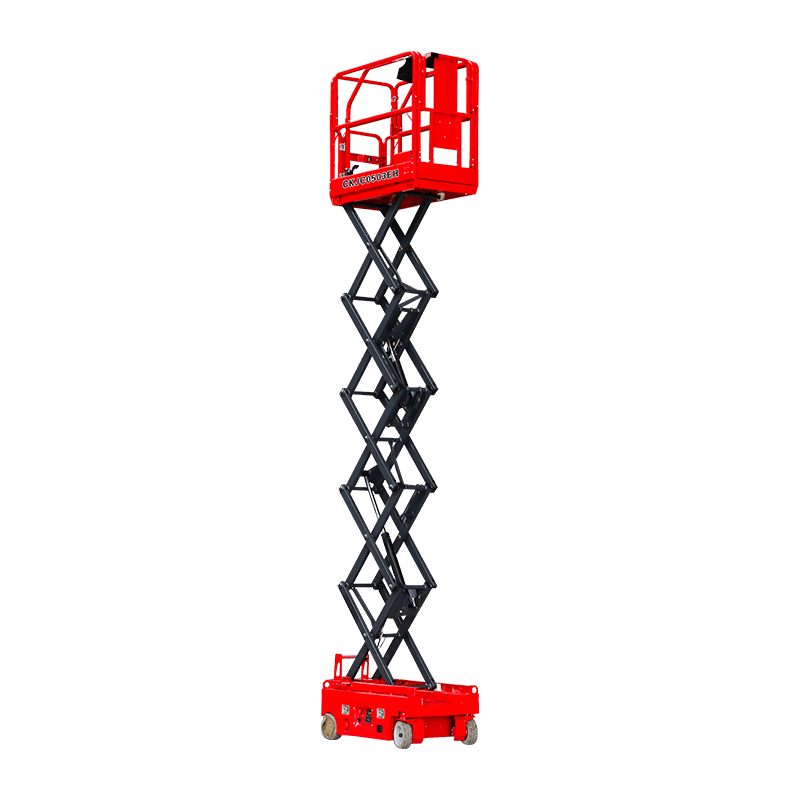 Wholesale CKJC0705EH CKJC0604EH CKJC0503EH Mini Electric Hydraulic steering MobiZhejiang Wizplus Smart Equipment Ltd is top China wholesale CKJC0705EH CKJC0604EH CKJC0503EH Mini Electric Hydraulic steering Mobile Scis...View Product →
For stairwell landings, mezzanine edges, and other confined positions, a single-mast lift is often the only powered platform that fits. Self-propelled single-mast units use one vertical mast and hydraulic lift to reach roughly 4 to 10 meters, with a small base radius that turns in corridors a scissor lift cannot enter.
Mobile stock pickers are built for order picking on shelves up to about 4 meters, with a platform that moves with the operator. High-altitude reclaimers reach similar levels for bulk picking and stock retrieval. Choose a reclaimer when the operator must reach forward into shelving; choose a scissor lift when platform area and load capacity matter more.
Standard models cover most requirements, but payloads above the catalog limit, unusually long platforms, or nonstandard lifting heights are common reasons to consider a built-to-order unit. A custom machine can be engineered with additional hydraulic capacity, reinforced structure, modified controls, or a chassis sized to the customer's floor plan. For these cases, a professional custom lifting platform is a way to get the exact specification instead of compromising with an oversized standard model.
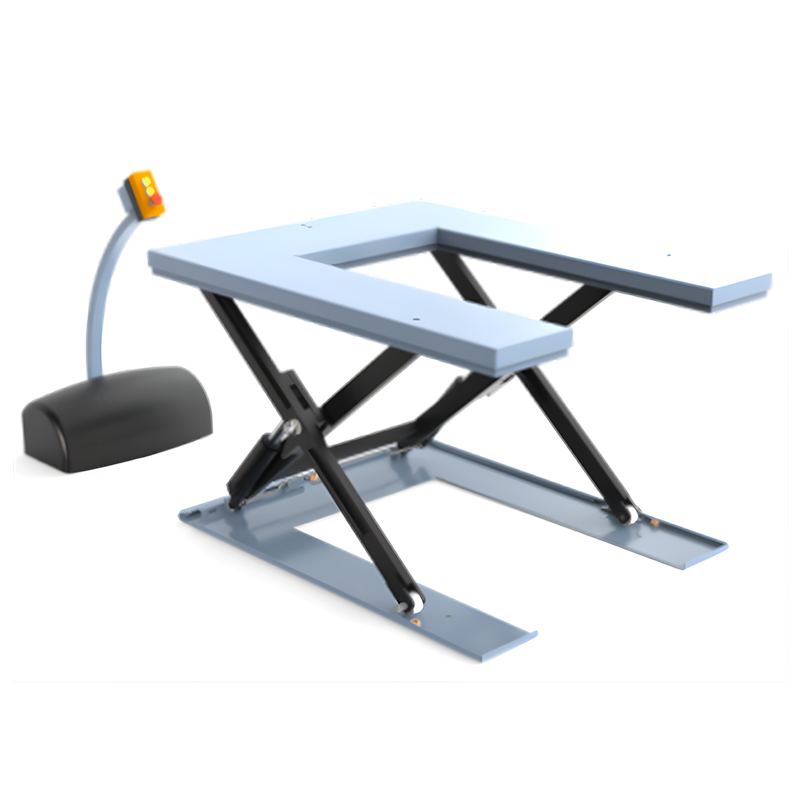 Wholesale 0-100000kg Professional Custom Lifting Platform Manufacturers, FactoryZhejiang Wizplus Smart Equipment Ltd is top China wholesale 0-100000kg Professional Custom Lifting Platform Manufacturers, Factory, Compa...View Product →
Specifications should be read as a system, not as a list of impressive maximums. The table below compares the main families relevant to a facility manager or contractor who needs a mobile hydraulic lift platform.
| Product family | Working height | Typical capacity | Drive type | Best suited for |
|---|---|---|---|---|
| Semi-electric scissor lift (CKJC0503Y - CKJC1614Y) | 5-16 m | 200-400 kg | Battery hydraulic lift; manual travel | General maintenance, installations, outdoor surfaces |
| Mini electric hydraulic steering scissor lift (CKJC0503EH - CKJC0705EH) | 5-7 m | 200 kg class | Battery traction; hydraulic steering | Narrow aisles, dense production floors |
| Mini universal-wheel scissor lift (CKJC0503EW - CKJC0705EW) | 5-7 m | 200 kg class | Battery lift; manual omnidirectional travel | Tight doorways, small work cells |
| Single-mast lift | 4-10 m | 100-200 kg | Electric self-propelled | Confined vertical access, one-person tasks |
| Mobile stock picker (OPC03, OPC04) | 3-4 m | 100-200 kg | Self-propelled electric | Order picking, stock counting |
| High-altitude reclaimer (CKOP30 - CKOP45) | 3-4.5 m | 100-200 kg | Full electric or half electric | Warehouse bulk picking, bin retrieval |
A few practical rules of thumb when comparing models:
A mobile hydraulic lift platform is a lifting machine, and its safety depends on structural design, hydraulic components, control systems, and operator habits. Certification matters first: manufacturers supplying the European market typically certify to CE machinery requirements, while ISO 16368 covers the design, calculations, safety requirements, and testing of mobile elevating work platforms. Ask for the compliance documentation and read the load chart before comparing prices.
Stability is governed by more than the nominal capacity. A concentrated load placed on one corner of a scissor platform can create an unstable condition well before the rated weight is reached. Load charts therefore specify both a maximum weight and, for most machines, a maximum number of occupants. Moving the platform while it is raised, or driving on a slope, is a leading cause of tip-over incidents and must be prevented by design interlocks or operating rules.
Well-built units include an emergency lowering valve so the platform can descend if the pump loses power, emergency stop switches at both the platform and the base, and, on self-propelled models, a tilt or slope alarm. Battery-operated machines also need a charging system that prevents deep discharge, since a depleted battery can leave operators stranded at height. For a deeper look at the inspection and operating checklist, see our electric scissor lift platform selection safety guide.
Purchase price is the visible cost; life-cycle cost is the one that matters. Over a five-year period, the largest cost components after the initial purchase are battery replacement, hydraulic component repair, and maintenance labor. When evaluating a mobile hydraulic lift platform, ask the supplier how each of these behaves in real use.
Battery life and charging turnaround matter in continuous two-shift operations. A machine that runs all day needs a charger matched to the shift pattern, and the battery chemistry and capacity should be sized for the actual daily duty cycle rather than the brochure. Hydraulic cylinders, hoses, and seals are the components most likely to need attention in heavy use, so ask which brands are used and whether spare parts are available from local distributors.
Maintenance skill is another practical consideration. Semi-electric machines with manual traction are simple to service with basic mechanical skills. Fully self-propelled machines add drive motors, controllers, and steering sensors that require electrical diagnostics capability. If the in-house maintenance team is small, the simpler drive system may be the wiser choice.
If the application involves heavy loads, unusual platform dimensions, or nonstandard floor conditions, a built-to-order unit can be more cost-effective than adapting a standard machine. Facilities with mixed lifting needs may also want to review which hydraulic lift fits their workshop before deciding, since the optimum machine type depends on the tasks performed regularly. We have covered the broader decision framework in our guide to choosing the right hydraulic lift for your workshop.
A mobile hydraulic lift platform is a long-lived capital asset. The engineering behind it matters more than the brochure photograph, and the manufacturer's own production capabilities are a strong indicator of quality. Ask for factory details: the size of the production site, the equipment used for cutting, forming, welding, and surface treatment, and the testing procedures for cylinders and complete machines.
Zhejiang Wizplus Smart Equipment Ltd. operates a 40,000-square-meter site in Deqing, Zhejiang Province, with about 20,000 square meters of factory space. The facility includes high-power laser cutting, CNC folding and bending, robotic welding lines, and automated spray lines for painting, powder coating, and electrophoresis. Vertical integration like this gives the company control over the steps that most influence hydraulic lift reliability: structural weld quality, surface protection, and assembly tolerances.
The product program includes aluminium alloy lifting platforms, scissor-type aerial work platforms, self-propelled order pickers, warehouse high-altitude reclaimers, and professional custom lifting platforms. Export experience includes factory visits from Algerian and Brazilian clients and participation at CEMAT Asia, which points to an established international sales channel. If you are evaluating a purchase, request reference lists, ask for load-test documentation, and, where practical, arrange a factory audit to see the testing equipment and quality-control process in person. For a broader view of how these machines fit into the wider equipment landscape, our engineering and selection guide to aerial work platforms is a useful starting point.
The CKJC0705EH CKJC0604EH CKJC0503EH mini electric hydraulic steering mobile scissor lift is designed for efficient oper...
The hydraulic self-propelled scissor lift aerial work platform can be easily driven and moved on flat and solid ground a...
This self-propelled single mast aluminum alloy lift platform is built with high-strength aluminum alloy, offering a ligh...
The mini electric mobile scissor lift with universal wheel integrates lifting, walking and operation functions. It adopt...

