A maintenance supervisor at a mid-sized distribution center has a recurring problem: the racking runs 7 meters high, but the aisles are only 1.6 meters wide. A standard scissor lift cannot turn into the bay, and ladders are banned by the company's work-at-height policy. The practical answer is a miniaturized scissor lift — a machine that keeps the lifting capability of a full-size platform while shrinking the chassis, wheelbase, and turning circle to fit where conventional units cannot go. Compact scissor lifts have become a standard equipment category for indoor maintenance, retail fit-outs, and warehouse operations, and choosing one requires looking beyond the height figure on the datasheet.
What Defines a Miniaturized Scissor Lift?
When a lift is described as "mini," the difference is not simply a shorter mast. A miniaturized scissor lift is engineered around three constraints: overall width, stowed length, and turning behavior. These dimensions decide whether the machine can pass through a standard door, travel along a narrow aisle, and position itself under a work area without repeated shunting.
Chassis footprint and aisle clearance
The most meaningful number for a buyer is the overall width of the machine. Full-size scissor lifts typically measure 1.2 to 1.5 meters wide, which rules them out for racking aisles under 2 meters. Mini units use a narrower wheelbase and tighter steering geometry to reduce the footprint to roughly 0.8 to 1.0 meter. That width lets the lift pass through standard doorways and operate in aisles that a conventional machine would block completely.
Working height versus platform capacity
Miniaturization involves a trade-off. Reducing the chassis size limits the battery package and hydraulic components that can be carried, so platform capacity typically settles in the 230–300 kg range. That is enough for one operator plus tools, but not for two workers or heavy replacement parts. The model designation in the CKJC series carries the height information directly: a 0503 unit provides a 3.0 m platform height and a 5.0 m working height, while the 0705 reaches a 5.0 m platform height and a 7.0 m working height.
Typical working height and footprint parameters for miniaturized scissor lift models in the CKJC series.
| Model series |
Platform height |
Working height |
Typical overall width |
| CKJC 0503 |
3.0 m |
5.0 m |
0.8–0.9 m |
| CKJC 0604 |
4.0 m |
6.0 m |
0.9 m |
| CKJC 0705 |
5.0 m |
7.0 m |
0.9–1.0 m |
Drive Systems and Maneuverability
The drive system determines how much physical effort the operator puts in over a shift. The main distinction is between semi-electric units, where the operator pushes the machine into position and the lift motor does the raising, and full-electric self-propelled units, where travel and lifting are both powered. In a mini format, the full-electric option is increasingly popular because the operator can drive the compact machine through a facility without manual pushing.
Full-electric self-propelled with hydraulic steering
For warehouses and production lines where operators move between multiple positions in a shift, hydraulic steering makes the lift easy to guide in confined spaces. The mini electric hydraulic steering mobile scissor lift, available in 5.0, 6.0, and 7.0 m working heights, uses an electric drive motor and hydraulic steering so the operator can turn the machine on the spot and approach racking faces at an angle rather than only head-on.
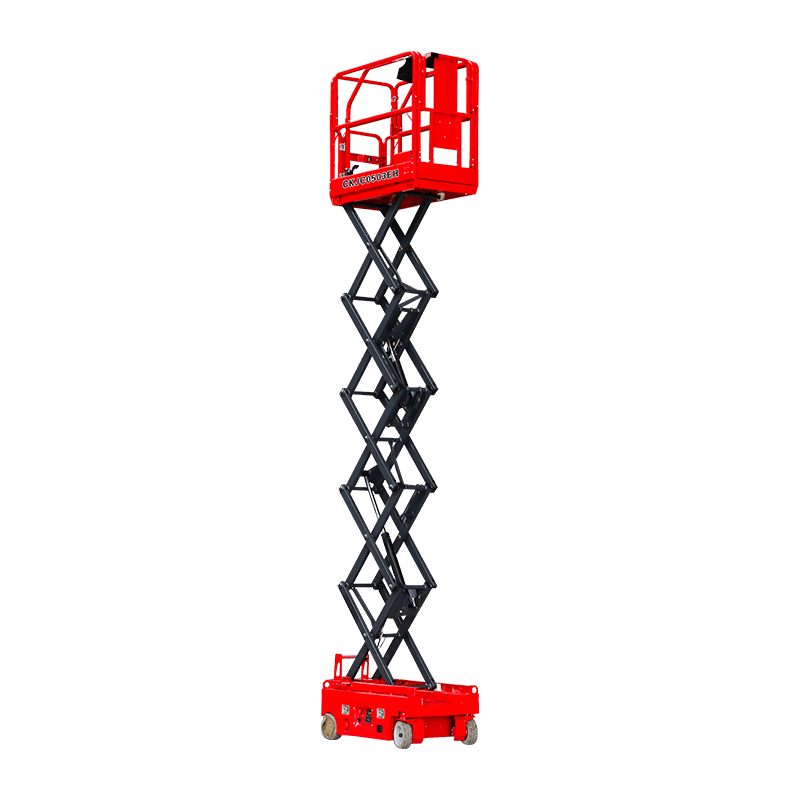 Wholesale CKJC0705EH CKJC0604EH CKJC0503EH Mini Electric Hydraulic steering MobiZhejiang Wizplus Smart Equipment Ltd is top China wholesale CKJC0705EH CKJC0604EH CKJC0503EH Mini Electric Hydraulic steering Mobile Scis...View Product →
Full-electric with universal wheels
An alternative approach uses swivel wheels instead of conventional steering. A mini electric mobile scissor lift with universal wheels can travel sideways as well as forward, which is especially useful when aligning the platform to a shelf face or working along a long wall. The operator does not need to plan a three-point turn; the machine simply moves in the direction the wheels are pointing.
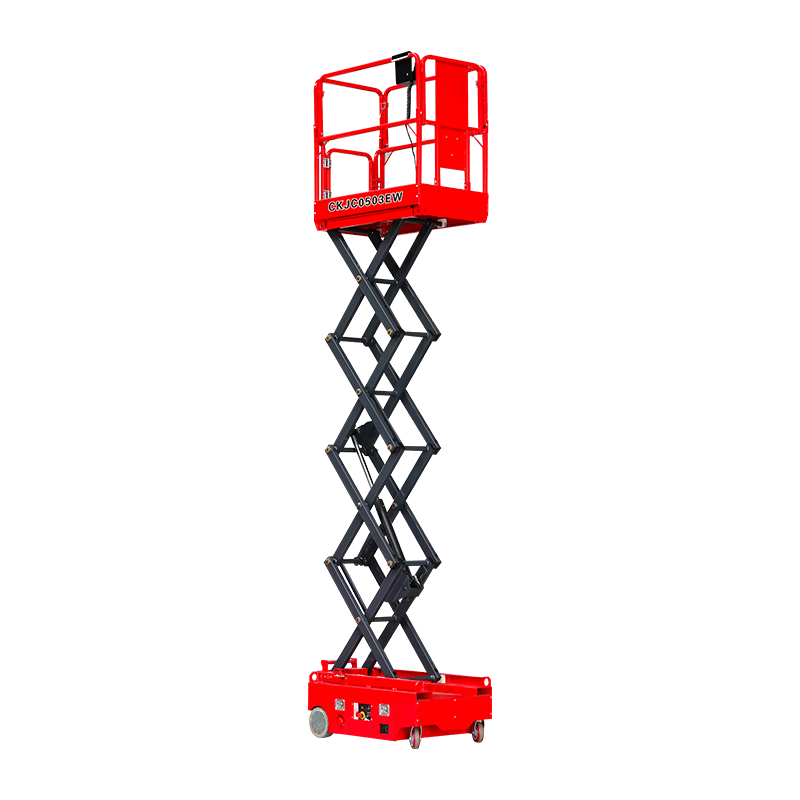 Wholesale Miniaturized Scissor Lifts Factory, CompanyZhejiang Wizplus Is China Wholesale Miniaturized Scissor Lifts Factory, Company, Its All-Electric Drive And Universal Wheel Design Greatl...View Product →
Drive system comparison for compact scissor lifts and the work patterns each one suits.
| Drive type |
Travel |
Lift |
Best suited for |
| Manual push-around |
Operator pushes |
Battery or manual pump |
Occasional short-duration maintenance |
| Semi-electric |
Push to position |
Electric lift motor |
Flat floors with infrequent repositioning |
| Full electric self-propelled |
Electric drive |
Electric lift motor |
Frequent movement across large interiors |
Structural Engineering That Keeps Compact Lifts Safe
The reason a mini lift can carry a person at 7 meters on a chassis under a meter wide is not the nameplate rating; it is the structural design behind it. When overall width shrinks, the stability margin has to come from other parts of the machine.
Scissor arm geometry and pivot bushings
Scissor arms in compact models are typically fabricated from high-strength steel with reinforced arm geometry calculated for a narrower base width. The pivot points carry the entire dynamic load during lifting, so precision bushings at each joint reduce play and prevent the platform from wobbling as the operator moves across the deck. A lift with excessive pivot clearance will feel unstable at height even if its load rating is technically correct.
Fabrication and quality-control practices
Because mini lifts are produced in higher volumes than custom platforms, the consistency of the fabrication process is critical. Laser-cut steel sections, CNC bending, robotic welding, and controlled surface treatment ensure that every frame in a production run matches the design geometry. The factory behind the CKJC series applies the same process discipline used for its larger aerial platforms: large-format laser cutting, 300-ton CNC press braking, robotic welding lines, and a multistage painting line with phosphating and electrostatic coating. The result is a compact lift with the same structural integrity as machines twice its size.
Safety Features That Matter in Tight Spaces
Platform-side protections
Mini scissor lifts use the same safety architecture as full-size units: guardrails around the platform, a toe board to stop tools from sliding off, emergency lowering valves that operate even with the battery depleted, and a tilt sensor that alarms when the chassis is out of level. In a narrow aisle, the tilt alarm deserves special attention, because operators often try to reach sideways beyond the platform edge. The sensor provides a clear warning before the stability envelope is exceeded.
Compliance with ISO and CE requirements
Compact lifts sold into European and other regulated markets are built to comply with ISO and CE requirements, and the factory should back that claim with documented test procedures. Buyers should ask for evidence of compliance testing for each model rather than accepting a generic certificate. A machine that looks sound on paper can still fail in service if the hydraulic hoses, electrical components, or weld quality have not been proven under load.
Maintenance and Inspection
In compact equipment, neglect shows up faster than in larger machines because the components are smaller and tolerances are tighter. A simple maintenance schedule protects both the operator and the investment.
Daily pre-use checks
Before each shift, the operator should check the hydraulic oil level, inspect the scissor arms for visible damage or leaking pivot seals, test the emergency lowering function, and verify that the guardrails are locked in position. The daily check on a mini lift takes less than ten minutes, but it catches most of the issues that otherwise cause downtime at height.
Monthly and annual service
Monthly service includes greasing the pivot bushings, checking battery condition and charging behavior, and inspecting the wheels or casters for uneven wear. An annual structural inspection should cover the scissor arm welds, the chassis frame, and the platform anchor points; this is where hairline cracks or corrosion will be found before they become a safety issue.
How to Choose the Right Mini Scissor Lift
The right mini lift for a facility depends on four questions: how high the work really is, how wide the access paths are, how often the machine will move during a shift, and what the floor surface is like.
- Measure the actual working height and add about 2 meters for the person's reach; that gives the required platform height.
- Measure the narrowest door, aisle, and elevator the lift must pass through; overall width is the deciding factor.
- Estimate movement frequency. If the operator will raise and lower more than ten times per shift, a full-electric drive pays for itself quickly.
- Check the floor condition. Expansion joints, thresholds, and gradients above 3 degrees will affect stability and steering behavior.
Racking aisles are where mini scissor lifts earn their keep. For very tight aisles, the narrow-body scissor lift series pushes overall width down even further and can be specified with special platform sizes or additional hydraulic functions through the factory's custom engineering service.
 Wholesale Mobile Hydraulic Lift Platform Factory, CompanyZhejiang Wizplus Is China Wholesale Mobile Hydraulic Lift Platform Factory, Company, It Drives Easily On Flat Ground And Construction Sit...View Product →
Before finalizing a purchase, work through a detailed electric scissor lift platform selection safety guide that covers load calculations and operational limits. The complete scissor lift aerial work platform family on the manufacturer's site provides comparative specifications across the semi-electric, mini, and narrow-body series, so the final decision can be made against real dimensions rather than marketing claims.
Miniaturized scissor lifts fill a gap full-size platforms never will: certified access to heights of five to seven meters in spaces measured in centimeters. The machine that fits the aisle, carries the operator safely, and survives years of daily use is the one selected with structure, drive train, and maintenance in mind — not just the height chart.

 English
 Español
 عربى
عربى