
 English
 Español
 عربى
عربى

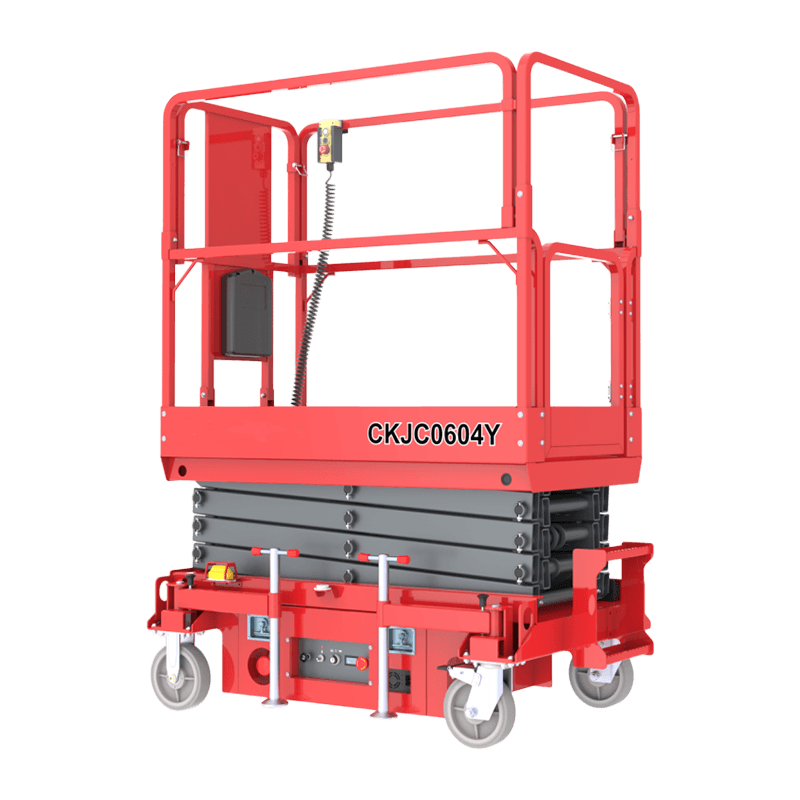
CKJC0705EW CKJC0604EW CKJC0503EW Mini Electric Mobile Scissor Lift with Universal Wheel
The mini electric mobile scissor lift with universal wheel integrates lifting, walking and operation functions. It adopt...

Content
Most electric scissor lift platform orders go wrong before the machine arrives. The buyer picks a working height by eye, then discovers the platform cannot pass through the warehouse door, or the machine needs constant pushing across a 60-meter floor. The fix is to define the machine by its real job site: how far it will travel between work positions, how wide the doors are, what slope the floor has, and how many people and tools will ride at once.
An electric scissor lift platform is a wheeled platform that rises vertically on crisscrossing linkage arms. An electric pump extends the arms, and the platform moves straight up, giving one or two workers a stable base for installation, maintenance, stocking, and repair work. The vertical-only movement is the key difference from boom lifts: these platforms work best when the task is directly above the machine and they take up less space while doing it.
The electric drive brings two practical benefits: no exhaust emissions and low noise. That is why these machines dominate indoor facilities such as production lines, retail stockrooms, aircraft hangars, cold storage, and food processing plants, where a combustion engine is not allowed.
Manufacturers build several drivetrain and footprint variants within this category. Zhejiang Wizplus Smart Equipment, for instance, produces semi-electric, mini electric hydraulic steering, universal-wheel, and narrow-body scissor configurations, each aimed at a different floor plan and workflow. Understanding those variants is the first step in choosing correctly.
Decision first: if the platform will be repositioned less than five times per hour and moved only short distances, a semi-electric machine is usually the cost-effective choice. If operators will travel hundreds of meters per shift, a self-propelled electric model pays for itself in reduced walking and pushing time.
A semi-electric scissor lift keeps the lifting function powered by an electric motor, but the operator pushes the machine to move and steer it. The advantages are a lighter, simpler machine, a lower purchase price, and easier battery maintenance. The limitation appears on large sites: moving a machine weighing several hundred kilograms by hand all day creates fatigue and slows the work.
A full-electric or self-propelled model adds a travel motor and power steering, and the operator rides the platform directly to each task. The extra components increase weight and cost, but the productivity gain on open floors is measurable. As a rule of thumb, once the average distance between lifts exceeds about ten meters, the self-propelled configuration starts to win.
For facilities with flat floors, small repair areas, and occasional use, the semi-electric series remains the most economical entry point into powered lifting.
 Semi-Electric Scissor Lift with Telescopic Platform and Folding GuardrailsThis compact semi-electric model fits tight storage and narrow pathways thanks to its folding guardrails and telescopic platform, making it a practical choice for flat-floor facilities that need occasional powered lifting without sacrificing space.View Product →
Floor space is often the factor that rules out a standard scissor lift. A machine with a wide platform may pass through the main loading door, then fail at the 90-degree turn into a storage aisle. Compact configurations solve that problem in different ways, and the right one depends on where the machine will work.
The mini electric hydraulic steering scissor lift uses hydraulic steering cylinders to turn the wheel set, which sharply reduces the turning radius. This configuration is designed for maneuvering in tight warehouse aisles, between production machines, and inside service areas where every centimeter matters.
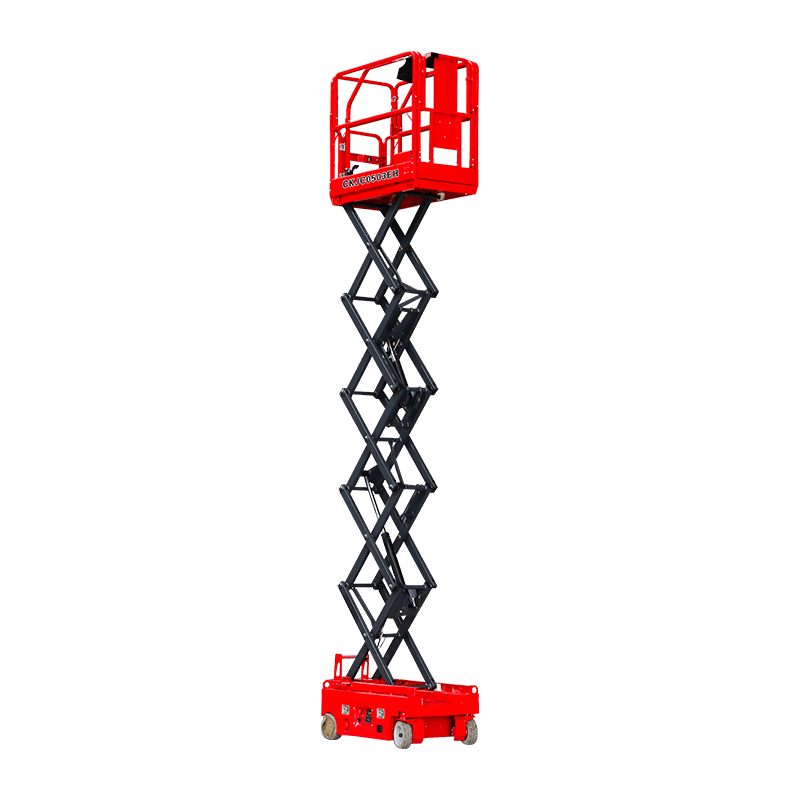 Mini Electric Hydraulic Steering Scissor Lift with Omni-Directional WheelsEquipped with hydraulic steering and omni-directional movement, this mini lift allows sideways travel in dense storage areas, reducing repositioning time and enabling precise alignment in narrow warehouse aisles and between machines.View Product →
The universal-wheel mini model adds omni-directional movement. The platform can move sideways as well as forward and backward, so the operator can align with a rack or machine without repeated forward-reverse corrections. In high-density storage, where there is no space to swing the machine around, that capability removes the most time-consuming part of positioning.
Where the limitation is a door rather than floor space, narrow-body scissor lifts reduce the overall width while keeping working height and lift capacity. They are built for standard single doors, narrow walkways, and rack rows that an ordinary platform cannot enter.
 Narrow-Body Hydraulic Self-Propelled Scissor Lift Aerial Work PlatformThis hydraulic self-propelled platform offers a narrow-body option for standard doors and rack rows, with stable hydraulic drive and up to 16 meters of working height, suitable for demanding outdoor construction and maintenance tasks.View Product →
When comparing electric scissor lift platforms, five specifications determine whether the machine earns its keep. The table below summarizes what each controls and the mistake most commonly made.
| Specification | What it controls | Common buying mistake |
|---|---|---|
| Working height | The maximum height the platform floor reaches | Specifying more height than the job needs, which adds weight and cost |
| Platform capacity | The combined load of workers, tools, and materials | Forgetting that the rating includes people; a 300 kg limit disappears quickly with two workers and a toolbox |
| Platform size | Whether long items such as cable trays or pipes fit safely on board | Choosing a short platform, then needing a second worker or a second lift for long material |
| Turning radius | The machine's ability to reposition inside aisles | Checking only doorway width and ignoring the 90-degree turn inside racking |
| Battery and charger | Shift coverage, recharge time, and daily operating routine | Choosing lead-acid when multi-shift operation demands rechargeable lithium cells or a spare battery |
Take the list to your site and measure: the aisle width at the base of the racks, not just at the entrance; the door frame height; the floor slope in the area where the platform will be raised; and the weight of the heaviest tool kit. These four measurements will filter out more unsuitable machines than any brochure.
The more height a platform provides, the more seriously you should treat its safety systems. Certification documents prove that a sample or a type has passed a test; site behavior is what protects operators on a daily basis. Verify both.
Key safety features to check on an electric scissor lift platform:
Ask the supplier to confirm compliance with applicable CE and ISO requirements and to provide test documentation for the actual machine serial number, not a generic certificate. Our electric scissor lift platform selection and safety guide explains the inspection points and test criteria in more detail.
Build a daily pre-use check into your routine: test the emergency controls, confirm the tilt alarm sounds, and inspect hoses for leaks. Most scissor lift incidents are caused by misuse of an otherwise sound machine: an overloaded platform, a machine used on a slope beyond its rating, or a missing pothole guard.
Over a five-year service life, the cost of running a scissor lift is usually dominated by batteries and hydraulics, not by the steel structure. Plan for these three areas and the machine will stay productive.
Batteries are the first area to manage. Lead-acid batteries need regular charging discipline and water checks; lithium batteries raise the upfront price but remove daily watering and allow opportunity charging during breaks. Match the battery technology to your shift pattern before you buy, because retrofitting later is expensive.
Hydraulic systems are the second. Check the oil level, inspect hoses and fittings for seepage, and keep cylinder rods clean. A small leak that is caught early is a fifteen-minute repair; the same leak ignored can contaminate the system and wear the pump.
Third, the scissor structure itself. The pivot pins and slide pads wear with use and need periodic lubrication. Worn pads create lateral play that shows up as platform wobble at height.
Supplier support is part of the maintenance equation. A manufacturer with export experience, a documented spare parts range, and responsive technical service shortens downtime. Zhejiang Wizplus Smart Equipment provides 24/7 technical support with its machines, which matters when a production line is waiting on a spare part.
Buying directly from the manufacturer changes what you can specify. Instead of accepting a standard configuration, you can request a different platform size, alternative battery type, special paint or finish, export packaging, or an added safety feature. Wizplus runs its own fabrication line, so custom requests can be settled before production rather than patched in later.
When you request a quotation for an electric scissor lift platform, ask the supplier to confirm in writing: rated load, working height, platform dimensions, charging time, turning radius, and the compliance documents that will be shipped with the machine. A written specification protects both sides and makes the final inspection a simple checklist.
Zhejiang Wizplus Smart Equipment builds electric scissor lift platforms for construction, industrial logistics, and warehouse operations, and ships them to international markets. If you are comparing machines for a specific site, start with the measurements listed in this guide and let the real conditions, not the tallest brochure figure, choose the configuration for you.
The mini electric mobile scissor lift with universal wheel integrates lifting, walking and operation functions. It adopt...
The CKJC0705EH CKJC0604EH CKJC0503EH mini electric hydraulic steering mobile scissor lift is designed for efficient oper...
Semi-electric scissor lifts platform are lighter and smaller in size, making it easier for workers to lift or lower the ...
The hydraulic self-propelled scissor lift aerial work platform can be easily driven and moved on flat and solid ground a...

