The most common mistake in buying a high-altitude lift platform is comparing machines by maximum height alone. A model that reaches the required working height can still fail on the job when it cannot fit through the access door, carry the tooling your crew depends on, or turn in the aisle where the work is done. The reliable sequence is to document the job site first, then evaluate machines against four constraints: working height, platform capacity, footprint, and power source. This guide walks through those constraints and explains when a standard scissor lift, a compact mobile unit, or a custom-built platform is the correct answer.
What Counts as a High-Altitude Lift Platform
A high-altitude lift platform is an access machine that raises an operator, together with tools and materials, to an elevated working position. The term covers several distinct families, each designed for a different combination of height, load, and mobility.
- Scissor lifts use linked arms to raise a large steel platform vertically. They are the default option for construction, facility maintenance, installation work, and agricultural buildings because the platform remains level and stable at full height.
- Single-mast lifts carry a small platform on a telescopic mast. Their narrow footprint fits through standard doors and into aisles where a scissor lift cannot go.
- Mobile stock pickers combine a small raised platform with wheeled mobility. They are built for order picking and stock counting at low and medium rack levels.
- High-altitude reclaimers are designed for retrieval from high racks. The operator positions the platform at shelf height and reaches into the storage depth safely.
The boundaries between these families are not rigid. Some manufacturers build scissor lifts with narrow platforms for aisle work and full-size platforms for open sites. One supplier covering the entire range simplifies maintenance, spare parts, and operator training.
The table below summarizes the main categories and their typical envelopes.
Typical working-height ranges and primary applications for the main platform families; confirm exact values on the manufacturer's specification sheet.
| Platform type |
Typical working height |
Primary applications |
Power options |
| Scissor lift |
4 m to 16 m |
Construction, installation, maintenance |
Semi-electric, full electric |
| Single-mast lift |
4 m to 10 m |
Narrow aisles, light installation |
Full electric |
| Mobile stock picker |
3 m to 4 m |
Warehouse order picking |
Full electric |
| High-altitude reclaimer |
3 m to 6 m |
High-rack storage retrieval |
Semi-electric, full electric |
The Specifications That Decide the Purchase
Three specifications do more to determine whether a platform suits a job than any other: working height versus platform height, payload, and power source.
Working height is the highest point an operator can touch, normally the platform height plus roughly 1.7 m of reach. If the task is changing a light fitting at 9 m, the platform must supply at least a 7.5 m platform height. Ordering by working height without subtracting the operator's reach is a frequent cause of machines being rejected on delivery.
Payload is the rated load on the deck, covering the operator plus tools and materials. A 230 kg rating suits one worker with a tool bag. Two workers with heavy installation equipment need a higher rating, and so does any job that carries a loaded tool cart on the platform.
Power source shapes daily operation. Semi-electric models lift electrically but are pushed or pulled when repositioning. They are lighter and less expensive, and they work well on smooth floors over short distances. Full-electric models drive themselves, which reduces operator fatigue and shortens cycle times in large buildings. Once the daily travel distance reaches several hundred meters, self-propelled operation usually pays for itself.
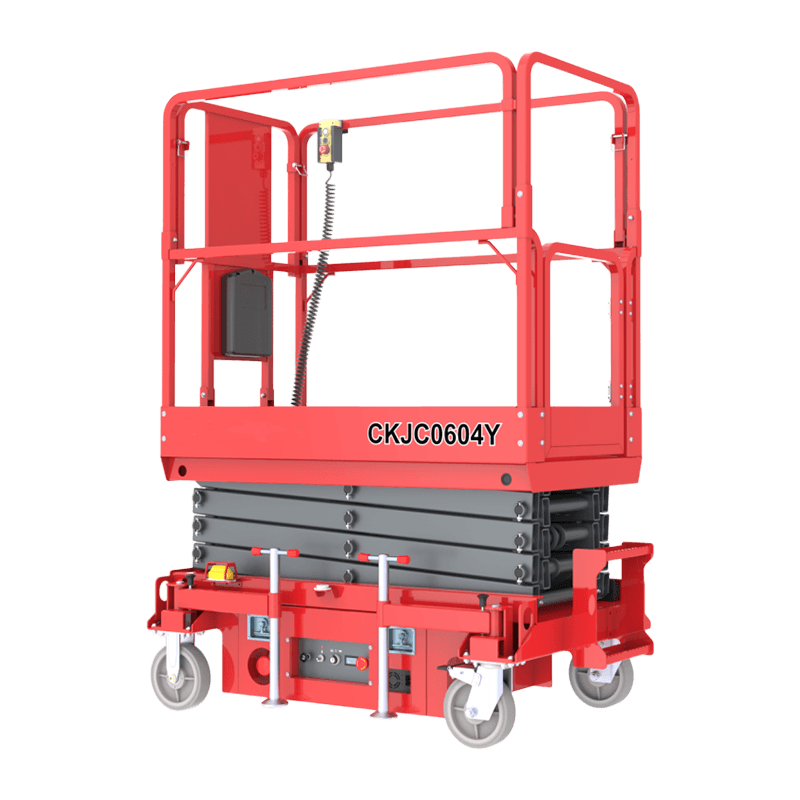 Semi-Electric Scissor Lift Platform with Telescopic DeckThis semi-electric scissor lift is manually pushed or pulled for repositioning, making it a practical choice for short-distance indoor tasks. Its compact folded size and emergency lowering system suit sites with limited space and access constraints.View Product →
Aisle Width and Site Constraints
Height and payload lose their importance if the machine cannot reach the work area. Site constraints eliminate most candidates before the first shift.
Doorways, corridors, and elevator access determine the maximum platform width. Narrow-body scissor lifts bring deck width down to pass standard door frames. Mini electric scissor lifts with universal wheels can rotate in place, which matters in crowded storerooms and workshops where a conventional turning radius is impossible.
In multi-story buildings, the machine may also need to travel in a freight elevator, which imposes a weight limit in addition to width limits.
In warehouse operations, the rack layout decides the machine family. Low-level order picking with frequent repositioning favors a mobile stock picker with a small footprint and quick movement between aisles. High-rack retrieval, where the operator reaches items at or above head height, calls for a reclaimer with stable mast geometry and sufficient platform depth. Measure the aisle width, rack depth, and pallet overhang before comparing models.
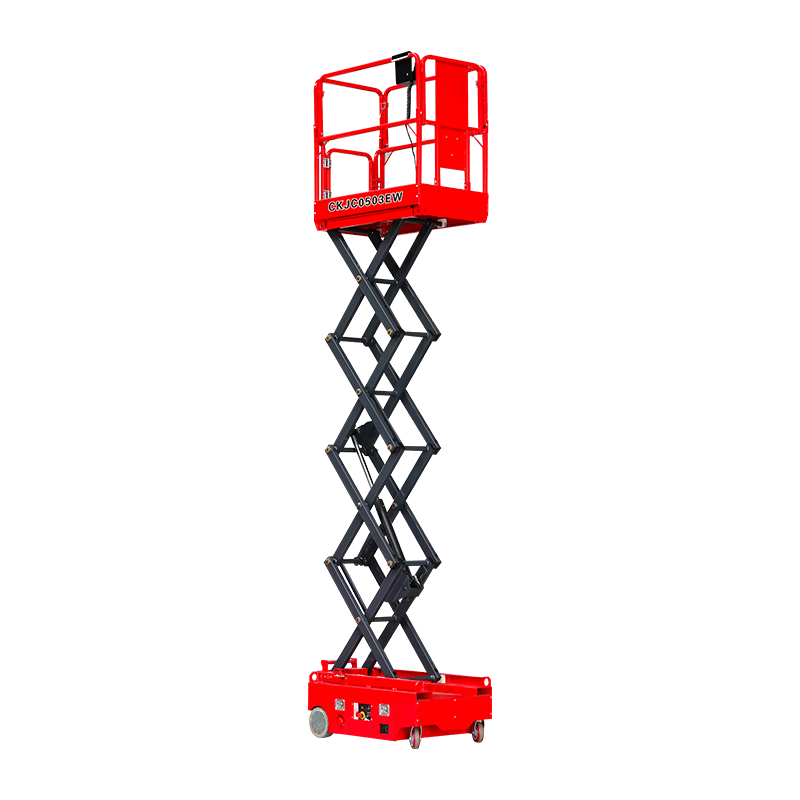 Mini Electric Mobile Scissor Lift with Omnidirectional WheelsThis fully electric mini lift features 360-degree in-situ turning and a narrow 800mm body, enabling agile movement in tight warehouse aisles. Its low noise output suits noise-sensitive indoor environments like shops and offices.View Product →
Safety, Standards, and Verification
Safety in a high-altitude lift platform comes from a system of features rather than a single component. Guardrails, anti-slip decks, emergency stop controls, and emergency lowering are the basics. Stability, however, is determined by the design margin in the mast, base, and lifting structure, and that margin is only as reliable as the factory testing behind it.
Also confirm the emergency lowering mechanism. A manual or battery-backed lower function lets the operator descend safely if the main power fails.
When evaluating a supplier, look for compliance with ISO and CE frameworks, and ask what test equipment the factory operates. A manufacturer with its own testing center can verify deflection, stability, and component endurance under controlled conditions. A certificate without a visible testing process is a procurement risk.
Service response is part of safety planning. A supplier with international export experience and around-the-clock support reduces the practical risk of downtime when a machine needs inspection or a spare part.
A supplier's production equipment is also a signal of quality. In-house laser cutting, robotic welding, and controlled surface treatment directly affect structural consistency and corrosion resistance. A manufacturer that completes the chain from steel fabrication to final assembly can deliver more consistent quality than one that simply assembles bought-in parts.
For a structured walkthrough of the category, see our guide on high-lift platform types and safety selection.
Custom Configurations for Non-Standard Jobs
Standard platforms cover a wide envelope, but some jobs fall outside it. A production line may require an elevated work deck with a specific length-to-width ratio. A maintenance task may involve a heavy component that exceeds the payload of every standard model. A loading operation may need a platform matched to a particular floor height or pit depth.
In these cases, a custom lifting platform removes the compromise. Custom engineering adjusts frame dimensions, mast height, platform size, and lifting mechanism to match a process. The same manufacturing line that builds standard scissor lifts can produce a one-off configuration with the same welding standards, laser-cut steel, and surface treatment. A manufacturer with its own fabrication facility can respond to custom requests without outsourcing critical steps.
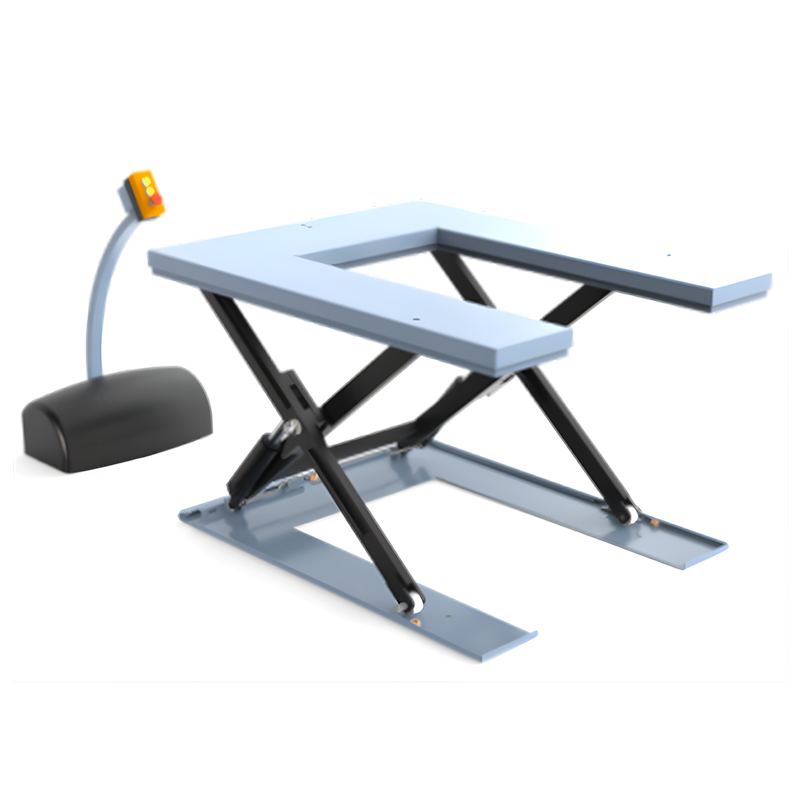 Custom Heavy-Duty Lifting Platform for Specialized NeedsThis custom lifting platform offers tailored frame dimensions, platform size, and lifting mechanisms for extreme capacities up to 100,000 kg. It includes high-precision controls and explosion-proof wiring options, addressing unique application requirements beyond standard catalogues.View Product →
Quick Selection Checklist
- Confirm the required working height, then subtract the operator's reach to obtain the minimum platform height.
- Total the operator, tools, and materials to define the minimum payload.
- Measure door widths, aisle widths, and turning space to fix the maximum platform footprint.
- Choose semi-electric power for short, flat travel distances and full electric power for large facilities.
- Match the machine family to the task: scissor lift for construction and maintenance, mini or narrow-body for confined spaces, stock picker for order picking, reclaimer for high racks.
- If no standard model meets all four constraints, request a custom configuration.
Defining these parameters in order reduces platform selection to a direct comparison of specifications. For most construction and maintenance work, a scissor lift is the correct starting point. For confined interiors, a mini or narrow-body unit fits where larger machines cannot. For high-bay warehouses, a stock picker or reclaimer matches the rack layout. And when the application falls outside the catalogue, a custom platform supplies the exact geometry and capacity required. Compare the full product catalogue, and verify every dimension against the measured conditions of your site.

 English
 Español
 عربى
عربى