
 English
 Español
 عربى
عربى

AM-S06 AM-S75 Self-Propelled Single-Mast Lift Platform
This self-propelled single mast aluminum alloy lift platform is built with high-strength aluminum alloy, offering a ligh...

Content
Aerial work platforms have become essential tools in modern construction, warehousing, and facility management. Among all available options, the electric mast boom lift stands out for its compact footprint, zero-emission operation, and precise vertical reach. This article explains how this machine works, what specifications matter most, and how procurement teams and wholesale buyers can make informed decisions.
An electric mast boom lift is a self-propelled aerial work platform that uses a telescoping or articulated mast mechanism powered entirely by an electric drive system. Unlike diesel-powered boom lifts, it relies on rechargeable battery packs — typically 24V or 48V deep-cycle lead-acid or lithium-ion units — to power both the drive motor and the hydraulic or electromechanical lift system. The operator stands on a platform at the top of the mast, using a control panel to raise, lower, and reposition.
Most commercial-grade units reach working heights between 4 m and 14 m. Compact models designed for low-clearance environments typically top out at 6 m, while heavy-duty variants can extend to 12 m or beyond. The working height is always measured from ground level to the top of the operator's outstretched hands — approximately 2 m above the platform floor.
Rated platform capacity for electric mast boom lift height and capacity specifications generally falls between 120 kg and 350 kg. Single-person models are rated at 120–200 kg, while two-person or tool-heavy applications require platforms rated at 230 kg or above. Always verify the Dynamic Load Index (DLI) in addition to static capacity when evaluating units for elevated assembly tasks.
The table below summarizes common specification tiers found across the market:
| Class | Max Working Height | Platform Capacity | Machine Weight | Aisle Width Required |
|---|---|---|---|---|
| Compact (Single-Person) | 4 m – 6 m | 120 – 160 kg | 350 – 700 kg | 0.75 m – 0.9 m |
| Mid-Range | 7 m – 10 m | 200 – 250 kg | 900 – 1,500 kg | 1.0 m – 1.2 m |
| Heavy-Duty | 11 m – 14 m | 280 – 350 kg | 1,600 – 2,500 kg | 1.3 m – 1.6 m |
The primary structural distinction lies in the lifting mechanism. A scissor lift uses a pantograph linkage that expands vertically but provides no horizontal outreach beyond the base footprint. An electric mast boom lift vs scissor lift comparison reveals that mast lifts offer a narrower chassis — often under 0.8 m wide — making them more suitable for confined spaces, whereas scissor lifts offer a larger platform area and higher lateral stability at medium heights.
Mast lifts are preferred for single-operator tasks in narrow aisles, server rooms, retail shelving, and indoor maintenance. Scissor lifts are better for tasks requiring multiple workers or heavy equipment on the platform, such as HVAC panel installation or structural steelwork.
| Feature | Electric Mast Boom Lift | Electric Scissor Lift |
|---|---|---|
| Chassis Width | 0.7 m – 1.0 m | 1.1 m – 1.8 m |
| Max Working Height | Up to 14 m | Up to 18 m |
| Platform Capacity | 120 – 350 kg | 250 – 680 kg |
| Horizontal Outreach | Limited or none | None (vertical only) |
| Indoor Suitability | Excellent | Good |
| Floor Load Impact | Low | Medium to High |
The electric mast boom lift for indoor use has three core advantages over combustion-engine alternatives: zero exhaust emissions, significantly reduced noise output (typically under 65 dB during operation), and non-marking polyurethane foam-filled tires that protect finished floors. These characteristics make it the default choice for food processing facilities, pharmaceutical cleanrooms, logistics centers, and museums.
When evaluating electric mast boom lift rental vs purchase cost, procurement teams must account for acquisition price, battery replacement cycles (every 3–5 years for lead-acid, 8–10 years for lithium-ion), annual servicing, and storage. A mid-range unit typically carries a capital cost between USD 8,000 and USD 25,000, depending on specification and origin market. Battery replacement alone for a 48V lead-acid system can run USD 800–1,500 per cycle.
Compliance with electric mast boom lift safety regulations and maintenance protocols is non-negotiable for B2B operators. Applicable standards include ANSI/SAIA A92.20 (North America), EN 280:2022 (Europe), and AS 1418.10 (Australia). These require load moment indicators, tilt sensors with automatic shutdown at gradients exceeding 1.5° to 3° (model-dependent), emergency lowering valves, and operator fall-arrest anchor points rated to at least 15 kN.
Most manufacturers specify a maximum permissible out-of-level gradient of 1.5° to 3° for operation. On surfaces outside this range, the built-in tilt sensor will prevent the mast from elevating. Always verify ground conditions before deployment. Do not use outriggers as a substitute for leveling the base chassis.
Under typical intermittent use (raise, position, lower cycles), a fully charged 24V or 48V battery system supports 6–8 hours of operation. Continuous drive cycles or cold-temperature environments (below 5°C) can reduce runtime by 20–30%. Lithium-ion systems generally outperform lead-acid in both runtime consistency and charge cycle longevity.
Licensing requirements vary by jurisdiction. In most EU member states and the UK, operators must hold an IPAF PAL card (category 1b for mast lifts) or equivalent national certification. In the United States, OSHA 1926.1431 requires documented operator training and evaluation but does not mandate a nationally standardized license. Employers are responsible for maintaining training records.
This self-propelled single mast aluminum alloy lift platform is built with high-strength aluminum alloy, offering a ligh...
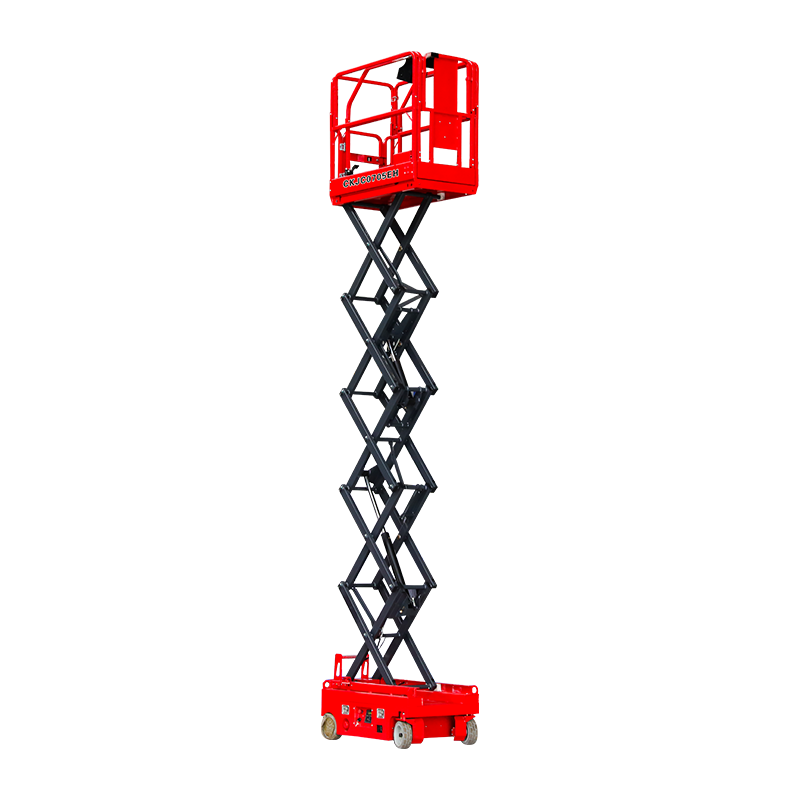
The mini electric mobile scissor lift with universal wheel integrates lifting, walking and operation functions. It adopt...
The CKJC0705EH CKJC0604EH CKJC0503EH mini electric hydraulic steering mobile scissor lift is designed for efficient oper...
Semi-electric scissor lifts platform are lighter and smaller in size, making it easier for workers to lift or lower the ...

