
 English
 Español
 عربى

AM-S06 AM-S75 Self-Propelled Single-Mast Lift Platform
This self-propelled single mast aluminum alloy lift platform is built with high-strength aluminum alloy, offering a ligh...

Content
A 9 m racking bay, a 1,200 kg pallet on the third level, and a 2.6 m aisle. Those three facts eliminate more lift platforms than any budget review ever will. The most common error when buying a high-altitude lift platform is comparing the "working height" printed on a brochure with the height of the job itself. Working height is almost always platform height plus roughly 2 m of operator reach, so a machine advertised at 8 m of working height gives you a platform floor at about 6 m. Get that sum wrong and you either buy a machine that will not fit the aisle or one that cannot reach the top beam.
The order that works: platform type first, then height, then power source, then floor-loading allowance. Steering arrangement, deck extension, and wheel material are consequences of those four decisions, not starting points.
"High-altitude lift platform" is a broad label covering any machine whose primary job is to raise a person, a load, or both to a defined working level. Suppliers use it interchangeably with aerial work platform, aerial lift, and lift platform, which is why two quotations for the same job can look so different on paper. What matters is that every machine is defined by three numbers: rated platform height, rated load, and the stability envelope it must stay inside.
The categories that matter most in day-to-day purchasing:
If you are still mapping the categories against each other, this high lift platform types and safety selection guide walks through the same comparison from a safety-planning angle.
Type selection is mostly about where the machine has to work, not how high it goes. A 6 m scissor lift and a 6 m mast platform reach the same beam, but only one of them will pass through a 900 mm door frame or sit on a mezzanine with a limited live-load allowance.
| Platform type | Typical platform height | Main constraint | Best-fit task |
|---|---|---|---|
| Scissor lift | 3 m to 16 m | Level hard floor, aisle width when stowed | Slab work, installation, maintenance, stock access |
| Mini electric scissor lift | 3 m to 7 m | Smooth floors, tight turning radius | Retail interiors, warehouse maintenance, confined work |
| Single-mast aluminium platform | 4 m to 12 m | Low point load limit, small deck | Indoor lighting, ceiling, and duct work |
| Order picker | 3 m to 4 m | Aisle width and racking interface | Piece picking at first and second rack levels |
| Warehouse high-altitude reclaimer | Up to about 4.5 m | Charging location, pallet access angle | Retrieving pallets and stock from high racks |
| Custom lifting platform | Job-specific | Structure, stroke, and load defined by the project | Non-standard loads, mezzanine feeds, special geometry |
Model codes are a useful shortcut once you know the convention. A suffix such as CKOP45 normally tracks the platform height class, and OPC03 and OPC04 indicate 3 m and 4 m order pickers respectively. Always confirm the number in writing, because a code tells you the class, not the deck size, the load rating, or the stowed dimensions.
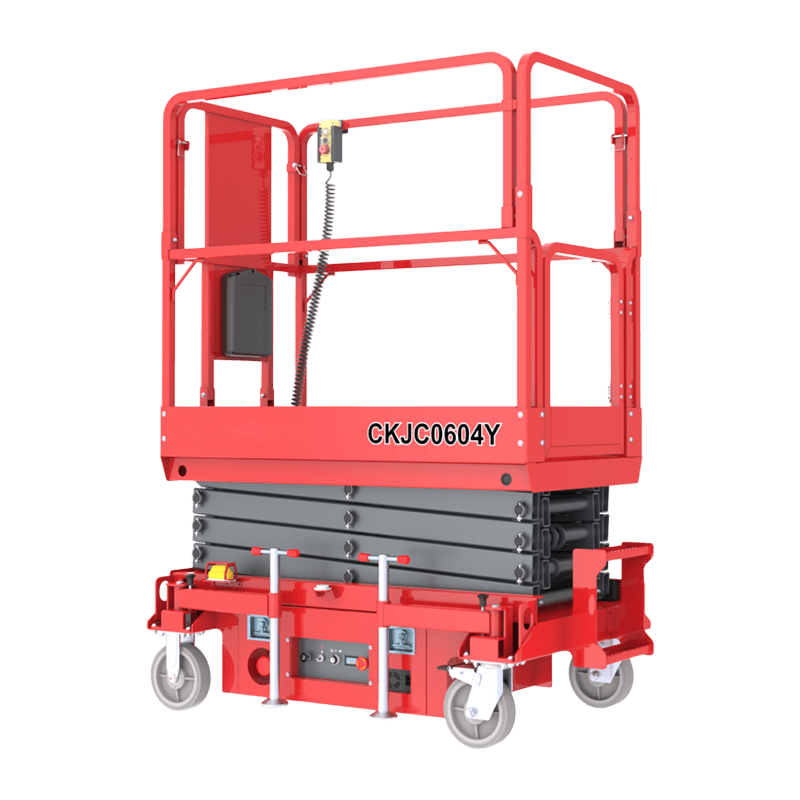 Semi Electric Scissor Lift Platform Series CKJC0503Y to CKJC1614YSemi-electric scissor lift range from compact 5 m class to taller models, with folding guardrails, reduced storage space, and ANSI, OSHA, CE, EN280 compliance.View Product →
Scissor lift families usually span several height classes on the same chassis design, which is convenient for fleets but easy to misread. The semi-electric scissor series, for example, covers a wide height band from compact 5 m class units up to tall models, so the height code matters more than the series name when you compare quotations.
Ask for both figures in writing, plus the roll-out deck length. A platform rated at 10 m working height with a 0.9 m extension is effectively three machines: 8 m standing, 8.9 m with the deck out, and whatever is left if the deck must stay retracted while travelling. If your task requires moving with the deck extended, that is a different machine class entirely.
Rated load covers the operator, tools, and material together. A two-person platform rated at 230 kg is generous for two people and their harnesses, and thin once you add a toolbox, a 40 kg panel, and a bucket of fixings. If the job lifts material as well as people, keep the planned load to about 70 percent of the rated figure and treat the remaining capacity as margin for wind and uneven deck loading.
Point load, not total machine weight, is what damages floors. A laden scissor lift on four small wheels can put more stress into a suspended slab than a heavier machine on wider tyres. Ask the manufacturer for the wheel point load in kN at rated load, then hand that number to the structural engineer rather than comparing it with the slab's total live-load figure. Wheel choice follows the floor: polyurethane or solid rubber for finished concrete, larger wheels for yard work, and universal casters where tight indoor manoeuvring makes a fixed steering axle impractical.
Semi-electric machines use manual propulsion with powered lift. They cost less, weigh less, and suit shops and warehouses where the operator moves the unit a few metres at a time. Full-electric self-propelled units cost more and cut fatigue across long shifts. For indoor use, confirm the battery chemistry, the charge time, and whether charging can happen at the point of use, because a machine that has to be driven to a charging bay every shift loses most of its advantage.
Warehouse work splits the market in a specific way. Above 3 m, the question stops being how high, and becomes what the operator is doing when they get there.
Retrieving a pallet from a high rack is a short-cycle lift-and-lower task. Reclaimer models such as the CKOP30, CKOP35, CKOP40, and CKOP45 are built for that pattern, with a compact deck and controls arranged for repeated short movements. Picking individual items at shelf level is a different motion altogether, which is why order pickers such as the OPC03 and OPC04 use a wider working area and a layout that keeps the operator facing the rack rather than reaching across it.
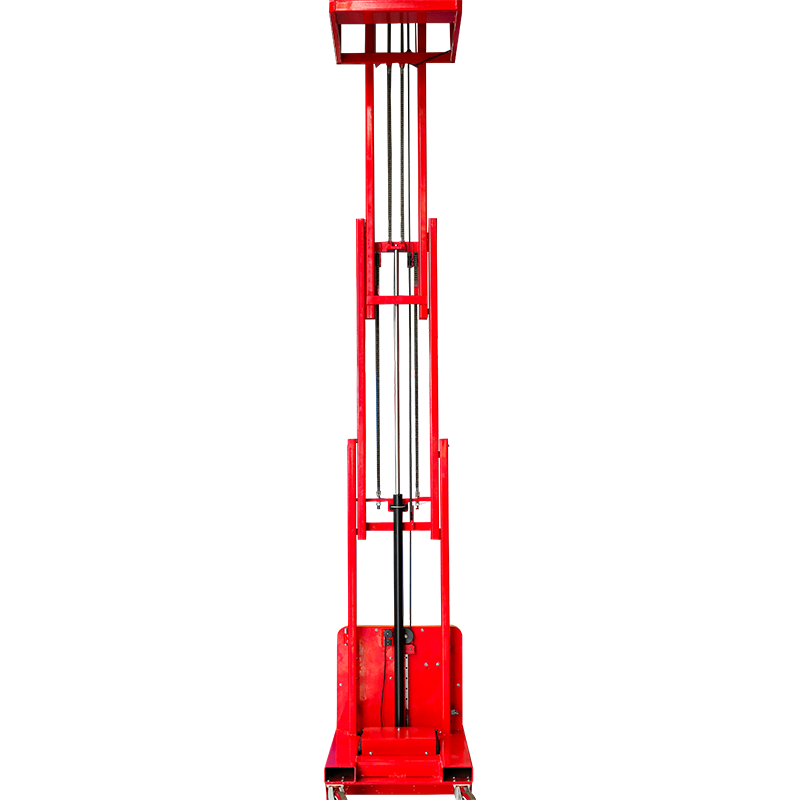 Self-Propelled Full Electric High-Altitude Reclaimer CKOP30-CKOP45Battery-powered high-altitude reclaimer with 300 kg load, zero-turn steering, and platform controls for repeated rack retrieval in warehouses and logistics.View Product →
Half-electric reclaimer series such as the CKOPY27 to CKOPY45 cover buyers who move the machine by hand between racks and only need power for the lift itself. That trade is worth reviewing honestly: manual travel is fine over a few metres, but across a 60 m aisle it becomes the reason a machine sits unused.
Standard platforms are dimensioned around other people's buildings: 800 mm doorways, 2 m aisles, 1,000 kg loads. When one of those assumptions fails, no catalogue model is the right answer, and stretching a standard unit past its envelope is how accidents get designed in.
Typical triggers for a non-standard build: a load above the standard deck rating, a fixed installation where the platform must sit flush with a mezzanine edge, a stroke longer than a single-scissor geometry can deliver, or a machine that has to pass through an opening narrower than any production chassis. High-capacity custom work also appears in materials handling, where platforms rated in the tens of tonnes replace ramps and fixed lifts.
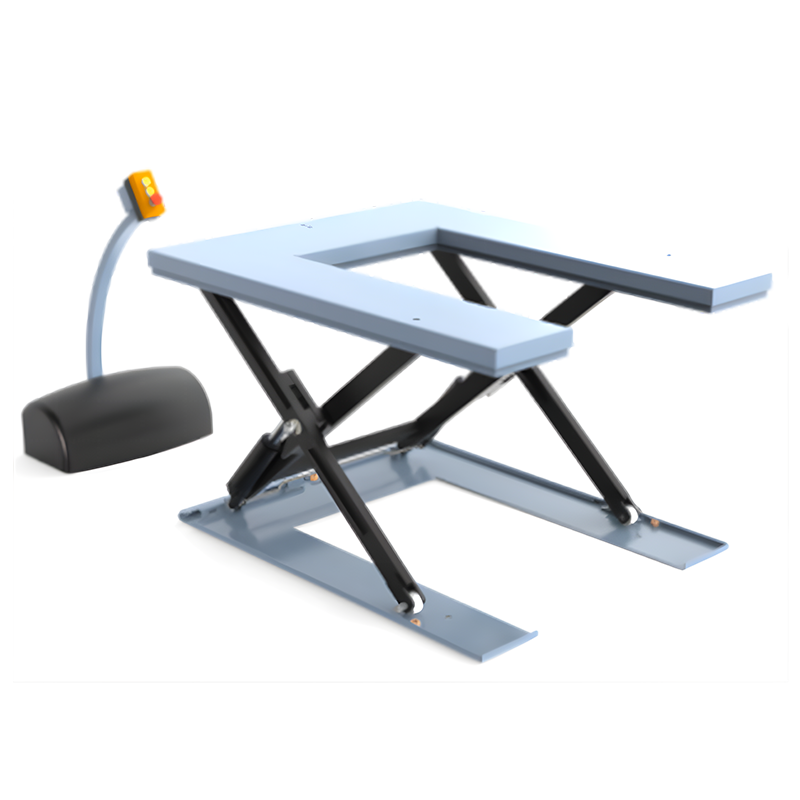 0-100000kg Professional Custom Heavy-Duty Lifting PlatformCustom heavy-duty scissor-based platform handling loads up to 100,000 kg, with high-precision control, multi-point synchronization, and explosion-proof wiring options for demanding projects.View Product →
Custom work changes the buying process. Instead of comparing datasheets, you are commissioning a design, so the specification document carries more weight than the brochure. Be explicit about the load, the stroke, the cycle rate, the mounting interface, and the environmental conditions, and ask for a drawing stamped for review before fabrication begins.
Certification is the baseline, not the differentiator. ISO and CE marking confirm that a design has been assessed against a recognised standard, but they do not tell you whether the arms on your particular unit were welded within tolerance. Ask for the test record for the specific serial number, along with the hydraulic schematic and wiring diagram, and make sure those documents are handed over with the machine.
Manufacturing capability shows up in lead time and in what can actually be built. A supplier with a 20 m steel workshop, a 300-tonne CNC press brake, 12,000 W laser cutting, and welding robot lines can hold tolerances on a long scissor arm that a workshop without that equipment cannot. That matters most on tall platforms, where a few millimetres of inconsistency across the arm set is felt as deck sway at full height.
Service and spares decide the second five years of ownership. Ask which wear parts are stocked, what the response time is outside normal hours, and whether the supplier supports export markets with documentation in the operating language. For buyers weighing an established aerial work platform manufacturer against a local distributor, spare parts availability and the willingness to release technical drawings usually settle the decision faster than price.
None of this is complicated, but it has to happen in the right order. Fix the working height, confirm what the floor will take, decide what the operator is actually doing at the top, and only then choose between a scissor lift, a mast platform, a reclaimer, or a custom build. Machines specified in that sequence tend to stay in service for their full design life; machines bought on a single height figure tend to be replaced early, and the replacement usually costs more than the original specification exercise would have.
This self-propelled single mast aluminum alloy lift platform is built with high-strength aluminum alloy, offering a ligh...
The lifting, movement and steering of the CKOP30 CKOP35 CKOP40 CKOP45 self-propelled full electric high altitude reclaim...
The hydraulic self-propelled scissor lift aerial work platform can be easily driven and moved on flat and solid ground a...
Semi-electric scissor lifts platform are lighter and smaller in size, making it easier for workers to lift or lower the ...

