
 English
 Español
 عربى
عربى

0-100000kg Professional Custom Lifting Platform
We have a professional team with decades of industry experience. Relying on the continuous in-depth development of the s...

Content
Industrial Equipment Explained
If you have ever watched a warehouse worker rise smoothly to a high shelf, or seen a mechanic's car lift off the ground without a single visible motor, you have already met a lifting platform. In the simplest terms, a lifting platform is a mechanical device that raises a load, whether that load is a person, a pallet, a vehicle, or a piece of machinery, from one height to another in a controlled way. The word "custom" simply means the platform's size, shape, load capacity, and lifting height have been adjusted to match a specific space or job, rather than being sold as one fixed, off-the-shelf design.
Unlike a passenger elevator, which moves inside a permanent shaft built into a building, a lifting platform is usually a standalone piece of equipment. It can sit on a warehouse floor, be recessed into a pit, or be mounted on wheels so it can travel between job sites. This flexibility is exactly why the Custom Lifting Platform category covers such a wide range of shapes and capacities, from small units that lift a single worker a few feet off the ground, to large industrial decks capable of raising several tons of freight.
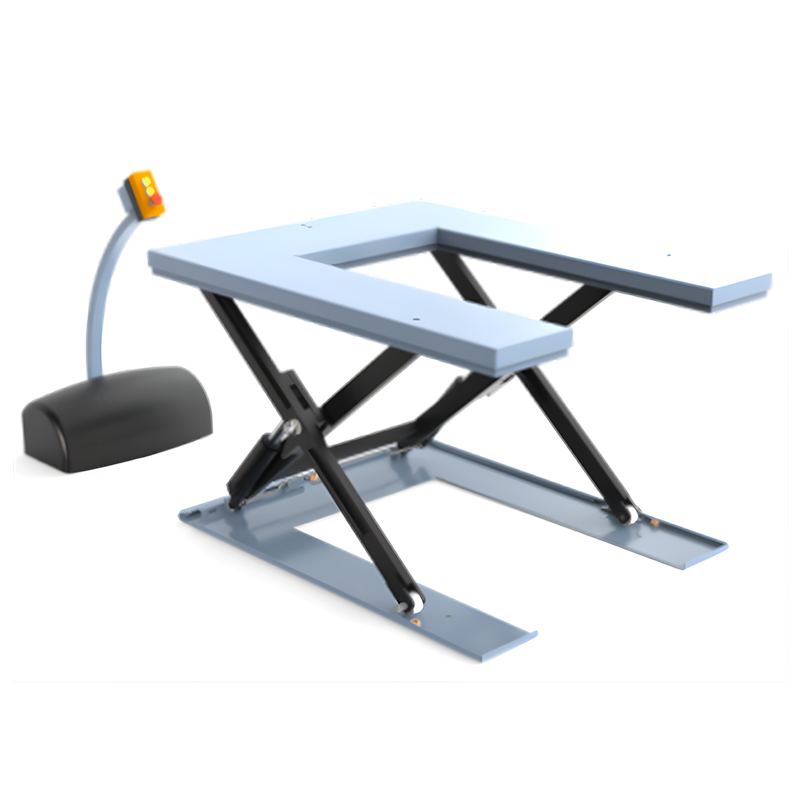
A simplified scissor-lift layout: the deck rides on crossed arms that a hydraulic cylinder opens and closes to raise or lower the load.
Most lifting platforms rely on one of three power sources: hydraulic, pneumatic, or mechanical/electric. A hydraulic system uses pressurized fluid pushed through a cylinder, similar in principle to how a car jack lifts a vehicle, only scaled up and automated. A pneumatic system uses compressed air instead of fluid, which tends to suit lighter loads and cleaner environments such as food processing areas. A mechanical or electric system uses a motor-driven screw or chain to physically wind the platform upward, which is common in smaller, slower-moving lifts where precision matters more than speed.
Regardless of the power source, the platform needs a structural mechanism to translate that force into upward motion while keeping the deck level. The most common mechanism is the scissor design shown above, where crossed metal arms fold and unfold like an accordion. As the hydraulic cylinder pushes the arms apart at their base, the deck rises in a straight vertical line. Other designs use vertical mast columns with a carriage that climbs the mast, which is typical of platforms built for greater heights rather than heavier loads.
Safety systems are built into every stage of this motion. Flow-control valves prevent the platform from dropping suddenly if a hose fails, mechanical locking bars hold the deck in place once it reaches height, and pressure-relief systems stop the lift from being pushed past its rated capacity. These features are what allow a lifting platform to be trusted with a person standing on it, not just cargo.
Because lifting platforms serve so many different jobs, manufacturers have developed several distinct types, each suited to a particular combination of height, load, and mobility. Below is an overview of the categories most commonly encountered.
Each of these categories can still be adjusted in size, deck material, capacity, and control layout, which is where the idea of customization comes in.
Yes. One of the defining features of a lifting platform, as opposed to a fixed elevator installation, is how many of its specifications can be tailored to a specific space or task. Customization typically covers several areas at once:
Because a Custom Lifting Platform is built around the specific dimensions and load requirements of a site rather than a one-size-fits-all template, it can often fit into spaces or work sequences that a standard, mass-produced lift simply cannot accommodate.
Technical spec sheets for lifting platforms can look intimidating at first glance, but each number answers a fairly ordinary question. The table below breaks down the specifications most people run into and explains what each one actually tells you.
| Specification | What It Actually Tells You |
|---|---|
| Load Capacity | The maximum safe weight the platform can carry at once, usually stated in kilograms or tons. |
| Platform Deck Size | The usable surface area, which determines how much cargo or how many people can stand on it comfortably. |
| Maximum Lifting Height | How high the deck can travel from its lowest resting position. |
| Lowered Height | How compact the platform folds down to, which matters for fitting into tight floor spaces or shallow pits. |
| Lifting Speed | How quickly the platform moves from bottom to top, affecting how many lift cycles can happen per hour. |
| Power Source | Whether the platform runs on hydraulic fluid, compressed air, or an electric motor. |
Lifting platforms are far more common in daily life than most people realize, they are simply easy to overlook once you get used to seeing them.
In warehouses and distribution centers, platforms raise workers safely to reach upper shelving or help load and unload trucks at dock height. In vehicle repair shops, low-profile lift platforms raise cars just enough for a technician to work comfortably underneath without crouching. On construction sites, mobile platforms move both materials and workers up to partially built floors before permanent stairs or elevators exist. In manufacturing plants, heavier-duty platforms move machinery components between production levels, since standard elevators are rarely designed for irregular industrial loads. Even in retail and event settings, smaller platforms are sometimes used to adjust stage height or move display materials during setup.
People often use "lift," "elevator," and "hoist" interchangeably, but each term describes something a little different. The comparison below highlights the key distinctions.
| Equipment | Typical Structure | Best Suited For |
|---|---|---|
| Lifting Platform | Standalone deck on scissor arms or a mast, movable or fixed | Flexible vertical access in warehouses, workshops, and job sites |
| Passenger Elevator | Enclosed cabin inside a permanent building shaft | Regular vertical transport of people within a fixed structure |
| Hoist | Cable or chain suspended from an overhead point | Lifting a load vertically from above rather than supporting it from below |
| Conveyor Lift | Continuous belt or roller system moving goods at an angle | Continuous, high-volume movement of uniform goods |
A few misunderstandings come up again and again when people first learn about lifting platforms. One common assumption is that a higher load capacity automatically means a bigger, bulkier machine, but modern scissor-arm engineering allows compact platforms to carry surprisingly heavy loads by distributing weight evenly across the crossed arms. Another misconception is that all lifting platforms need a pit cut into the floor, when in fact many mobile and low-profile designs sit entirely above ground level. Finally, some assume customization only affects appearance, when in practice it changes core engineering decisions such as arm thickness, hydraulic cylinder size, and deck reinforcement.
The core value of a lifting platform is not the machine itself, but the flexibility it gives a workplace. Buildings are expensive and slow to modify, but a lifting platform can be installed, repositioned, or replaced far more easily than a permanent elevator shaft. As warehouses, workshops, and production facilities continue to handle a wider variety of load shapes and sizes, having equipment that can be matched to the exact task rather than forcing the task to fit a fixed machine has become an increasingly practical way to keep daily operations moving safely and efficiently.
A custom lifting platform is, at its core, a simple idea executed with careful engineering: use a controlled mechanical or hydraulic force to raise a deck safely to a needed height, then shape every dimension of that deck around the specific job it needs to do. Understanding the basic mechanism, the main types available, and which specifications actually matter makes it much easier to recognize why these platforms look so different from one facility to the next, and why that variation is a feature, not an inconsistency.
What is the purpose of a lifting platform?
Its purpose is to raise people, goods, or equipment safely and predictably from one height to another, usually in settings where a permanent elevator is not practical.
How does a hydraulic lifting platform work?
Pressurized fluid is pushed into a cylinder, which extends and pushes against the platform's support arms or mast, raising the deck in a controlled, steady motion.
What is the difference between a lift and a lifting platform?
"Lift" is often used as a general term, while a lifting platform specifically refers to standalone equipment with an open or enclosed deck, as opposed to a cabin built into a permanent shaft.
Can a lifting platform be customized for specific needs?
Yes, load capacity, deck size, lifting height, travel speed, and safety features can all be adjusted to match a particular space or task.
What are the main types of lifting platforms?
Common types include scissor lift platforms, mast lift platforms, fixed dock lifts, mobile lift platforms, vehicle lift platforms, and heavy-duty industrial platforms.
How much weight can a lifting platform hold?
This varies widely by design, from a few hundred kilograms for light-duty units to many tons for heavy industrial platforms, depending on how the platform is engineered.
Are lifting platforms safe for everyday use?
When built with proper locking mechanisms, pressure-relief systems, and load limits, and operated within their rated capacity, lifting platforms are designed for regular daily use.
What industries commonly use lifting platforms?
Warehousing, vehicle maintenance, construction, manufacturing, and logistics are among the most common industries relying on this equipment.
We have a professional team with decades of industry experience. Relying on the continuous in-depth development of the s...
This self-propelled single mast aluminum alloy lift platform is built with high-strength aluminum alloy, offering a ligh...
The hydraulic self-propelled scissor lift aerial work platform can be easily driven and moved on flat and solid ground a...
Semi-electric scissor lifts platform are lighter and smaller in size, making it easier for workers to lift or lower the ...

